
Lending money to a friend, colleague, relative, or even a business contact usually starts with trust. Most people do not ask for agreements, witnesses, or written contracts while helping someone financially. The problem begins when repayment dates keep changing, calls start getting ignored, and suddenly the borrower behaves like the money never existed.
In India, this situation is more common than many people think. Sometimes the amount is small, around ₹10,000 or ₹20,000. In other situations, people end up losing savings running into lakhs. What makes things emotionally difficult is that these disputes usually happen between known people. It is not just a financial issue anymore. It becomes personal.
Many people also stay confused about whether the matter is civil or criminal. Some think police will immediately recover the money. Others assume nothing can be done legally unless there is a signed agreement. The reality lies somewhere in between.
If someone borrowed money and is not returning it, Indian law does provide remedies. But the practical approach matters more than emotional reactions. A wrong step, public threats, abusive messages, or social media defamation can sometimes create additional legal complications.
This guide explains what actually works in such situations, what legal remedies are available in India, when police intervention becomes relevant, and what practical steps may improve your chances of recovering the money.
Why These Money Disputes Become Complicated
Most friendly loans in India happen informally. A person transfers money through UPI, bank transfer, or cash because somebody urgently needed help. Very few people think about future disputes at that moment.
The problem starts when repayment excuses become repetitive:
“Next month pakka.”
“Salary delayed.”
“Business issue chal raha hai.”
“I will send partial amount tomorrow.”
In some cases, the borrower genuinely faces financial difficulties. But there are also situations where repayment avoidance becomes intentional. The person may stop replying completely, block calls, or even relocate to another city or country.
Legally, the intention behind borrowing money becomes very important. Indian courts often distinguish between:
- Genuine inability to repay
- Fraudulent intention from the beginning
This distinction decides whether the matter remains a civil dispute or may also attract criminal liability.
What to Do if Someone borrowed money and Is Not Returning it?
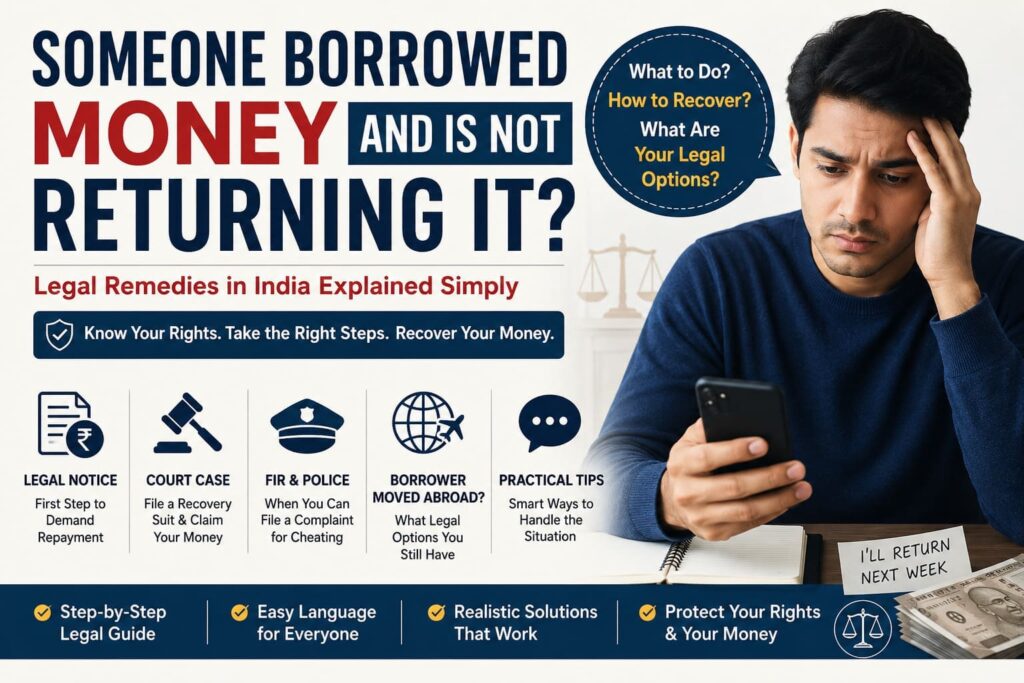
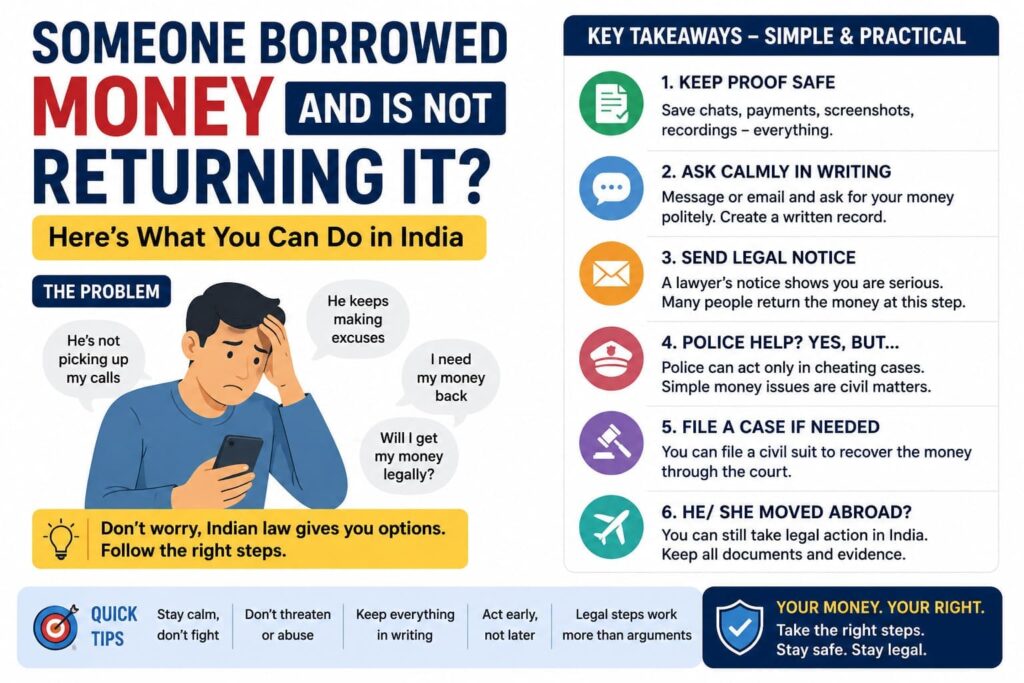
The first reaction of many people is anger. They either start threatening the borrower or continuously call and abuse them. That usually weakens the case instead of improving it.
A more practical approach works better.
Preserve Every Piece of Evidence
Before taking any legal action, gather all available proof connected to the transaction.
This may include:
• Bank transfer screenshots
• UPI transaction history
• WhatsApp chats
• Emails
• Loan acknowledgments
• Voice recordings if legally obtained
• Witness conversations
• Promises regarding repayment dates
Even a simple WhatsApp message like “I will return your money next week” can become valuable evidence later.
Many people wrongly assume that absence of a written agreement means there is no case. Indian courts can still consider digital evidence and transaction records.
Does a Friendly Loan Become Legally Enforceable?
Yes, in many situations it can.
A friendly loan is still a financial transaction. If there is evidence showing:
• transfer of money
• acknowledgment by borrower
• repayment promise
then the lender may pursue legal remedies.
However, practical recovery depends heavily on documentation quality. Cash transactions without proof become harder to establish compared to digital transfers.
This is one reason digital payments have become important in modern recovery disputes.
Civil Dispute or Criminal Case
This is where many people get confused.
Not every unpaid loan automatically becomes a criminal offence.
Civil Nature of the Dispute
If somebody borrowed money honestly but later failed to repay due to financial problems, the matter is generally treated as a civil recovery issue.
In such cases, legal remedies usually involve:
• legal notice
• recovery suit
• summary suit
• mediation or settlement
Criminal Angle
A criminal complaint may arise if there is evidence suggesting dishonest intention from the beginning.
For example:
• fake promises used to obtain money
• false identity or forged documents
• deliberate cheating scheme
• borrower never intended to repay
In such cases, provisions relating to cheating under Bharatiya Nyaya Sanhita may become relevant.
Police authorities often examine whether the dispute is purely financial or contains elements of fraud and deception.
Can Police Recover Your Money
Many people immediately go to the police station expecting direct recovery.
Reality is slightly different.
Police generally avoid interfering in purely civil money disputes. If the matter appears to be a simple unpaid loan without fraud, they may advise parties to approach civil court.
However, police intervention may become relevant if:
• borrower used fake identity
• forged documents were involved
• there was intentional deception
• multiple victims were cheated similarly
If the police refuse to register FIR despite clear cheating allegations, remedies may still exist under criminal procedure laws.
In such situations, understanding the difference between FIR and complaint becomes important. You can internally link your article:
Many people also confuse an FIR with a simple police complaint, even though both have different legal implications in recovery disputes. You can read this for more information.
But incase if police refuses to file FIR than what are the remedies that you can follow in this senario. You can have a look on this topic, What to Do When Police Refuses to File FIR: Know Your Rights and Next Steps”
This creates strong topical relevance for Google while helping readers naturally navigate connected legal concepts.
Send a Proper Written Demand Before Legal Action
One practical mistake people make is relying only on verbal conversations.
Instead, shift communication into written form.
A calm and professional message often works better than emotional arguments.
The purpose is simple:
• create evidence
• show seriousness
• document repayment demand
• avoid unnecessary aggression
Do not use abusive language or public threats. Those messages can later be used against you.
In many real situations, borrowers start responding seriously only after realizing that documentation is being preserved properly.
Legal Notice for Recovery of Money
A legal notice is usually the first formal legal step.
An advocate sends an official notice demanding repayment within a specified period. The notice generally contains:
• details of transaction
• amount due
• repayment history
• legal consequences of non payment
Many disputes settle at this stage itself because borrowers realize the matter may escalate legally.
For smaller amounts, a legal notice may be more practical than immediately filing a lengthy court case.
Civil Suit for Recovery of Money
If repayment still does not happen, the lender may file a civil recovery suit.
The court process depends on factors such as:
• amount involved
• nature of evidence
• written agreement availability
• transaction history
In straightforward cases involving clear documentary proof, a summary suit under Order XXXVII of the Civil Procedure Code may sometimes be considered.
This procedure is generally faster compared to ordinary civil trials because the defendant gets limited opportunity to delay proceedings without showing genuine defence.
Still, many people should understand that litigation takes time. Court action should be viewed as a strategic decision, especially when legal expenses become higher than the disputed amount itself.
What if Someone Borrowed Money and Moved Abroad
This situation creates panic for many lenders.
People often believe recovery becomes impossible once the borrower leaves India. That is not entirely true.
Legal action can still continue depending on facts and evidence.
If the borrower moved to Dubai, UAE, Canada, UK, or another country, the lender may still:
• send legal notice
• initiate Indian proceedings
• preserve digital evidence
• track communication records
However, international recovery is practically more complicated and expensive.
Indian embassies usually do not recover private debts for citizens because these are treated as personal civil disputes. At best, embassy or consular offices may provide limited guidance.
In reality, recovery success in overseas situations often depends on:
• documentation quality
• borrower’s continuing Indian connections
• family pressure
• employment stability
• settlement negotiation
Many people underestimate how effective professional legal communication can become once the borrower realizes formal proceedings may affect future travel, reputation, or financial dealings.
What if the Borrower Starts Threatening You Instead
This also happens frequently.
Once repayment pressure increases, some borrowers become aggressive. They may:
• threaten physically
• abuse on calls
• intimidate socially
• issue false allegations
In such situations, preserve evidence carefully.
Avoid retaliatory threats.
If intimidation becomes serious, legal remedies relating to criminal intimidation or harassment may arise separately.
This is also where understanding your rights during police interactions becomes useful.
“What Are Your Rights During an Arrest? 7 Crucial Rights Police Can’t Ignore”
Can WhatsApp Chats Become Evidence in Court
Yes, in many situations digital communication can become relevant evidence.
Indian courts increasingly consider:
• WhatsApp chats
• emails
• transaction records
• screenshots
• digital acknowledgments
However, authenticity and proper presentation matter.
Deleting chats, editing screenshots, or selectively presenting conversations can create evidentiary issues later.
It is always better to maintain original records and backup copies.
Is It Worth Filing a Case for Small Amounts
This is probably the most practical question people hesitate to ask.
Legally, even smaller amounts can be recovered through legal remedies. But from a practical perspective, litigation cost and time must also be considered.
For example:
If somebody owes ₹10,000 and court expenses become ₹25,000 plus years of litigation, settlement or negotiated recovery may sometimes make more sense.
This does not mean you should ignore the issue completely. It means strategy matters.
Sometimes a professionally drafted legal notice itself pushes repayment because the borrower understands the matter will not disappear quietly.
Common Mistakes People Make During Money Recovery Disputes
Publicly Defaming the Borrower
Posting allegations on social media without caution may expose you to defamation claims.
Taking Illegal Recovery Measures
Threats, harassment, forced entry, or unlawful pressure can create criminal liability against the lender.
Ignoring Documentation
People often rely on trust instead of preserving proof.
Waiting Too Long
Delays weaken evidence and recovery momentum.
Emotional Communication
Angry messages often damage negotiation possibilities.
Practical Steps That Sometimes Work Before Court
Many money disputes get resolved before formal litigation when pressure is applied intelligently and legally.
Some practical approaches include:
Structured Repayment Plan
If the borrower genuinely lacks funds, a written instalment arrangement may help.
Mutual Mediation
Trusted common contacts can sometimes resolve matters faster than litigation.
Written Acknowledgment
Even obtaining written confirmation of debt can strengthen future legal remedies.
Professional Legal Communication
People often ignore emotional requests but respond seriously to formal advocate notices.
Consumer Law Angle in Certain Situations
Some money disputes may overlap with consumer protection issues.
For example:
• advance payment for services never delivered
• fraudulent online sellers
• fake business investment schemes
• coaching institutes or vendors refusing refunds
In such cases, remedies under consumer protection laws may also become relevant depending on the facts.
Digital fraud cases may additionally involve cybercrime reporting mechanisms.
Online Transactions and Cyber Concerns
Modern money disputes increasingly involve:
• UPI transfers
• fake investment links
• social media borrowing scams
• online marketplace fraud
If money was obtained through online deception, cybercrime reporting portals and banking grievance systems may also become relevant.
RBI regulated banking procedures, transaction dispute mechanisms, and digital fraud reporting timelines can sometimes affect recovery possibilities.
This broader regulatory context adds practical value to the legal strategy.
How Courts Usually View These Cases
Courts generally look at:
• whether money transfer actually happened
• whether repayment obligation existed
• whether borrower acknowledged liability
• whether dishonest intention existed
Judges also examine conduct of parties carefully.
For instance, repeated repayment promises followed by deliberate disappearance may create stronger inferences compared to a genuine financial crisis.
This is why preserving conversations matters so much.
Realistic Expectations About Recovery
One of the biggest mistakes legal blogs make is promising guaranteed recovery.
Reality is different.
Some disputes settle quickly. Others continue for years.
Recovery chances improve significantly when:
• digital evidence exists
• written acknowledgments exist
• borrower has stable income or assets
• legal action begins early
• communication remains professional
At the same time, emotionally driven reactions often reduce settlement chances.
Frequently Asked Questions
Legal FAQ
Money Recovery Questions
Clear answers on borrowed money disputes, UPI transfers, recovery suits, and related practical issues.
Can I file FIR if someone is not returning borrowed money?
An FIR may be possible if there is evidence of cheating or dishonest intention from the beginning. Pure repayment disputes are often treated as civil matters unless fraud elements exist.
What if someone is not returning my money after UPI transfer?
UPI transaction records can become important evidence in recovery proceedings. Supporting chats and repayment acknowledgments strengthen the case further.
Is a legal notice compulsory before filing a recovery suit?
Not always legally compulsory, but practically very useful. Many disputes settle after formal legal notices.
Can I recover money without written agreement?
Yes, depending on available evidence such as bank transfers, WhatsApp chats, emails, witnesses, and acknowledgments.
What if the borrower blocks my number?
Continue preserving evidence. Avoid harassment. Formal legal communication through advocate notice may still reach the borrower.
Can Indian court take action if the person moved abroad?
Indian legal proceedings may still continue depending on facts, though international enforcement becomes more complicated practically.
How long does money recovery case take in India?
There is no fixed timeline. It depends on evidence quality, court workload, and whether settlement occurs during proceedings.
Conclusion
Someone borrowed money and is not returning it is not just a legal issue. In many Indian families and friendships, it becomes emotionally exhausting. People hesitate to act because they fear damaging relationships or getting trapped in lengthy court procedures.
Still, ignoring the issue completely usually encourages further avoidance.
The smartest approach is balanced action. Preserve evidence. Stay professional. Avoid emotional threats. Try structured communication first. If the borrower continues ignoring repayment despite clear obligations, legal remedies such as advocate notices, civil recovery proceedings, or criminal complaints in fraud situations may become necessary.
Indian law does provide options, but recovery success often depends less on dramatic confrontation and more on documentation, patience, and strategic legal action.