
Many employees search on Google for help when they are facing a difficult situation: employer not paying salary. Salary delays or complete non-payment can create serious stress. Rent, loans, family expenses, and daily needs all depend on regular income. When a company not paying salary continues to delay payments, employees often feel helpless and confused about what they can legally do.
If you are going through a situation where employer not paying salary, it is important to know that Indian law provides several remedies to protect employees from non payment of wages. You do not have to silently accept the situation. There are practical steps you can take to recover your salary and protect your rights.
This guide explains your rights in simple terms and shows you what you should do next if your company not giving salary or if your employer refuses to pay you. It also explains the legal options available when you are dealing with the problem of employer not paying salary, so you can understand the correct steps to take and recover the money you have rightfully earned.
Situations involving employer not paying salary can sometimes raise concerns about fairness and equal treatment, which is why understanding the Right to Equality under Article 14 of the Indian Constitution becomes important.
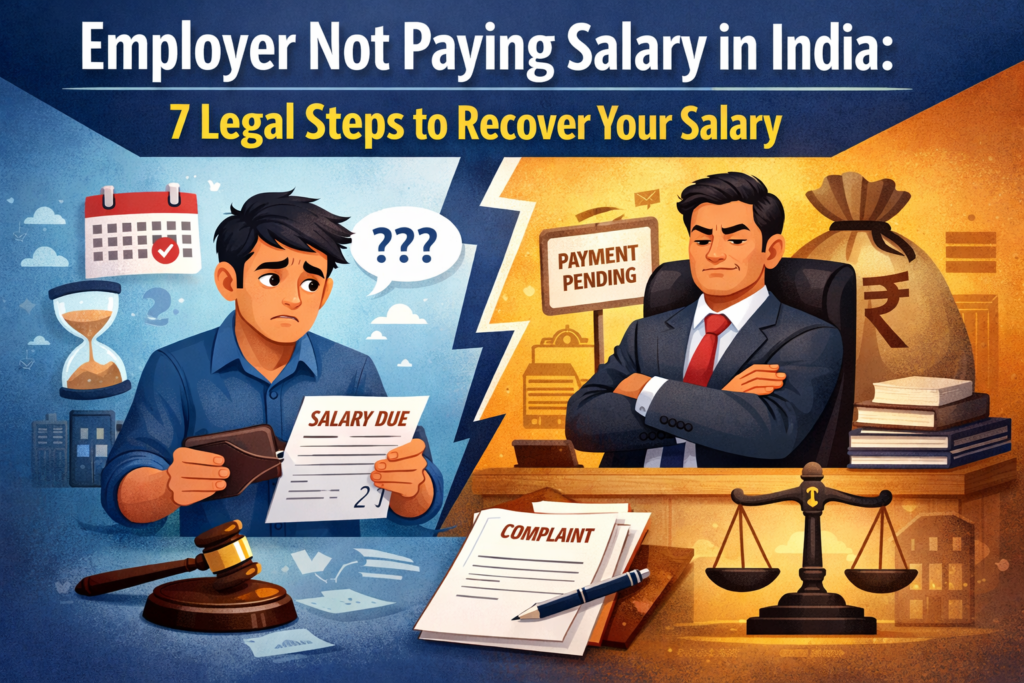
Understanding the Problem: When an Employer Does Not Pay Salary
Salary disputes can happen in many forms. Sometimes the employer delays payment by a few days. In other situations, employees may not receive their salary for several months.
Here are some common situations employees face:
- Salary delayed for two or three months
- Employer keeps promising payment but never transfers the salary
- Employer stops paying salary after the employee resigns
- Company shuts down operations without clearing employee salaries
- Employer withholds salary as punishment or pressure
When these situations occur, it may amount to non payment of wages, which can be illegal depending on the circumstances.
For example:
A software developer worked for a startup for four months. The company kept saying that funding was coming soon and salaries would be cleared. After several months, the company stopped responding. In such a case, the employee has the right to initiate legal action to recover the unpaid salary.
If employer not paying salary, the law provides several remedies to recover the amount.
While labour laws specifically deal with salary disputes, understanding the broader framework of Fundamental Rights in India also helps employees become more aware of their legal protections.
What Happens If an Employer Doesn’t Pay Salary?
In some situations, the problem of employer not paying salary may also involve arbitrary or unfair treatment, and the principle of equality under Article 14 of the Indian Constitution helps ensure that laws are applied fairly.
Indian labour laws are designed to ensure that employees receive their wages on time. When a company fails to pay salary without a valid reason, the employee can take legal steps.
Possible consequences for the employer include:
- Complaint filed before the Labour Commissioner
- Legal notice demanding payment
- Labour court case
- Civil recovery suit
- Court order requiring payment of salary with interest
In many cases, when there is a dispute involving an employer not paying salary, employers choose to settle the matter once they receive a legal notice from a lawyer because they want to avoid legal proceedings.
For example:
An employee working in a retail store did not receive salary for three months. After sending a legal notice through an advocate, the employer cleared the full salary within two weeks.
This shows that taking formal action can often solve the problem quickly.
How Many Days Can a Company Hold Your Salary in India?
One of the most common questions employees ask is how long an employer can legally delay salary.
Under the Payment of Wages Act, 1936, wages should normally be paid:
- Before the 7th day of the next month in smaller establishments
- Before the 10th day of the next month in larger establishments
If an employer delays salary beyond this period without a valid reason, it may be considered unlawful.
Another important situation arises when an employee leaves the company.
When an employee resigns or leaves the job, the employer must complete the full and final settlement within a reasonable period. Many companies complete this process within 30 to 45 days.
However, if the company not giving salary even after resignation, the employee can demand payment through legal means.
Example:
An employee resigned from a marketing company, but the employer refused to release two months of salary and incentives, creating a situation of employer not paying salary. After filing a complaint with the labour department, the company was directed to clear the pending salary.
Common Reasons Employers Give for Not Paying Salary
Employers often provide different explanations when salary payments are delayed. Some of the most common reasons include:
- Company facing financial problems
- Cash flow issues
- Disputes about employee performance
- Company closing down operations
- Disagreement about resignation or notice period
However, financial difficulty is generally not considered a valid legal excuse for non payment of wages.
Employers are responsible for paying employees for work that has already been performed. If an employee has worked during a certain period, the employer must pay the agreed salary, and a situation of employer not paying salary can raise serious legal concerns under labour laws.
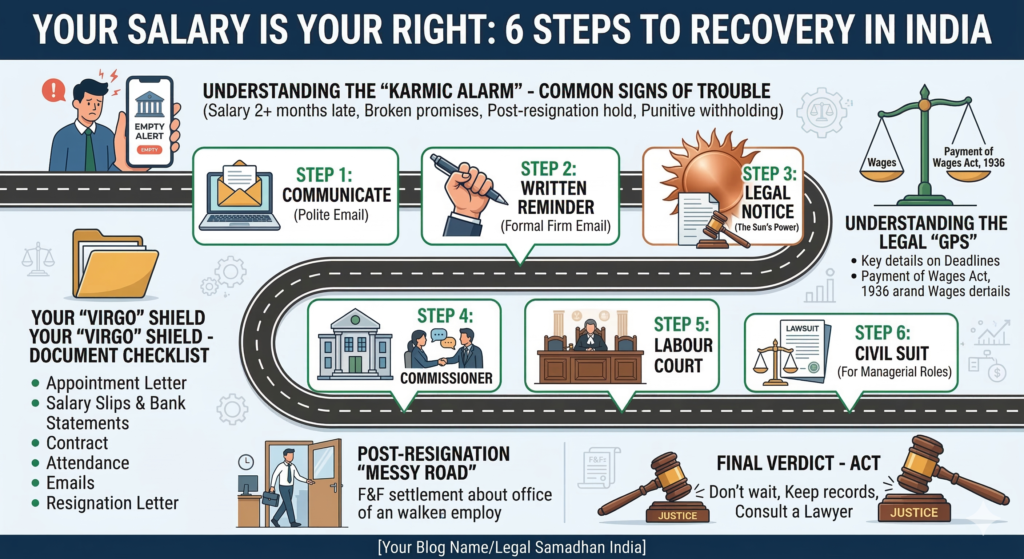
If Employer Not Paying Salary – Step-by-Step Legal Action
If your employer is not paying salary, it is advisable to follow a structured approach before taking legal action.
Step 1: Communicate with the Employer
Start by speaking to your employer or HR department.
Sometimes salary delays happen due to administrative issues or misunderstandings.
You may send a polite email asking for clarification.
Example:
You can write to HR asking when the pending salary will be credited.
Always keep a written record of such communication.
Step 2: Send a Written Reminder
If the employer continues to delay salary, send a formal reminder through email.
Mention:
- Amount of salary pending
- Period for which salary is unpaid
- Request for payment within a reasonable time
Written communication becomes important evidence if the matter later goes to court.
Step 3: Send a Legal Notice
If the employer still does not respond, the next step is sending a legal notice through an advocate.
A legal notice typically includes:
- Details of employment
- Amount of unpaid salary
- Demand for payment within a specific time
- Warning of legal action if payment is not made
In many cases, employers clear the salary after receiving a legal notice.
Step 4: File Complaint with Labour Commissioner
If the salary is still not paid, you can file a complaint with the Labour Commissioner in your area.
The labour department may:
- Call both parties for discussion
- Investigate the matter
- Direct the employer to pay the pending salary
This process is often quicker and less expensive than court litigation.
Step 5: File Case in Labour Court
If the matter is not resolved through the labour department, the employee can approach the Labour Court.
Labour courts handle disputes related to employment and wages.
The court can order the employer to:
- Pay pending salary
- Pay compensation
- Pay interest on delayed salary
Step 6: File a Civil Recovery Suit
In some cases, employees may not qualify as “workmen” under labour law.
For example:
- Managers
- Senior executives
- Highly paid professionals
Such employees may need to file a civil recovery suit in civil court to recover unpaid salary.
Legal disputes often involve principles of fairness and classification, and understanding the Doctrine of Reasonable Classification helps explain how courts evaluate whether different treatment is legally justified.
Where to Complain Against an Employer Who Is Not Paying Salary
Employees often ask where they should file a complaint when a company not paying salary.
Here are the main options:
Labour Commissioner Office
This is usually the first place to approach.
The labour department can investigate salary disputes and attempt settlement.
Labour Court
If the dispute is not resolved, the employee can file a case in labour court.
Civil Court
For managerial employees or contractual disputes, a civil recovery case may be filed.
Online Government Portals
Some labour departments allow employees to submit complaints online through government official portals.
Before filing a complaint, it is helpful to gather all employment documents.
Documents Required to Recover Unpaid Salary
To successfully recover unpaid salary in a situation involving employer not paying salary, it is important to keep proper documentation.
Helpful documents include:
- Appointment letter
- Offer letter
- Salary slips
- Bank statements showing salary deposits
- Employment contract
- Attendance records
- Email communication with employer
- Resignation letter if applicable
These documents help prove:
- You were employed by the company
- You performed the work
- Salary was not paid
Without documentation, it may become difficult to establish the claim.
Employer Not Paying Salary After Resignation
Many employees face salary issues after leaving the company, especially in situations where an employer not paying salary delays or refuses to clear the employee’s final dues.
A common complaint is:
“My employer refuses to pay me after I resigned.”
In such cases, employers sometimes try to withhold salary citing reasons like:
- Notice period disputes
- Performance issues
- Company policies
However, employers generally cannot withhold salary for work already completed.
If your company not giving salary after resignation, you should take the following steps:
- Send a written request for full and final settlement
- Ask for details of pending salary and dues
- Send legal notice if payment is not made
- Approach labour department if necessary
Employees are entitled to receive salary for the period they actually worked.
Penalty for Employer for Non-Payment of Wages
Employers who refuse to pay salary, leading to a situation of employer not paying salary, may face legal consequences.
Possible penalties include:
- Payment of pending salary
- Interest on delayed wages
- Compensation to employee
- Legal costs
- Court orders against employer
Courts may also direct employers to clear salary within a fixed timeframe.
These penalties encourage employers to resolve disputes quickly.
Real-Life Example of Salary Recovery
Consider this example.
A sales executive worked for a company for six months. The employer delayed salary payments repeatedly and eventually stopped paying altogether, creating a situation of employer not paying salary. The employee tried speaking with HR but received no response.
The employee then took the following steps:
- Sent an email requesting salary payment
- Sent a formal reminder after two weeks
- Sent a legal notice through a lawyer
- Filed a complaint with the labour department
After receiving the notice and labour complaint, the company cleared the full salary along with pending incentives.
This example shows that taking proper legal steps can often resolve the issue.
What Should You Do Now?
If you are currently facing a situation where your employer refuses to pay you, it is important to act carefully and systematically.
Here is a simple action plan.
First, gather all employment documents such as appointment letters, salary slips, and emails.
Second, write to your employer asking for the pending salary and keep records of communication.
Third, if the employer continues to delay payment, consult a lawyer and send a legal notice.
Fourth, file a complaint with the labour department if the issue remains unresolved.
Taking early action can often help recover the salary without lengthy litigation.
Frequently Asked Questions About Unpaid Salary
1. Can I file a police complaint if employer does not pay salary?
Generally, salary disputes are treated as civil or labour matters. Police complaints are usually not the first option unless fraud or criminal misconduct is involved.
2. What if the company shuts down without paying employees?
Employees can still file claims before labour authorities or courts to recover unpaid salary from the employer.
3. Can employer hold salary after resignation?
Employers cannot arbitrarily withhold salary for work already completed. If salary is withheld without valid reason, employees can pursue legal remedies.
4. How long does a salary recovery case take?
The timeline depends on the legal route taken. Labour department complaints may resolve faster than court cases.
5. What if my company not paying salary for several months?
The timeline depends on the legal route taken. Labour department complaints may resolve faster than court cases.
6. What if my company not paying salary for several months?
You should begin with written communication and legal notice. If payment is still not made, you can approach the labour department or court.
Conclusion
Facing a situation where an employer not paying salary can be stressful and confusing. However, employees in India are protected by labour laws that ensure they receive wages for their work.
If your company not paying salary, you should not ignore the problem. Start by communicating with the employer, keep proper records, and take legal steps if necessary.
In many cases, a formal legal notice or labour complaint can help resolve the issue quickly. Acting early and understanding your rights can significantly improve your chances of recovering the unpaid salary.
When dealing with issues such as employer not paying salary, it is always helpful to understand not only labour laws but also the broader constitutional framework, including the Fundamental Rights in India that protect individuals against unfair practices.
Pingback: Sick Leave in India: 9 Surprising Rights Your Employer Won’t Tell You