
If you searched “is company bond legal in India”, chances are you are dealing with a real situation—maybe your employer is asking you to sign a bond, or worse, demanding money because you want to leave.
Let me give you a clear, practical answer first:
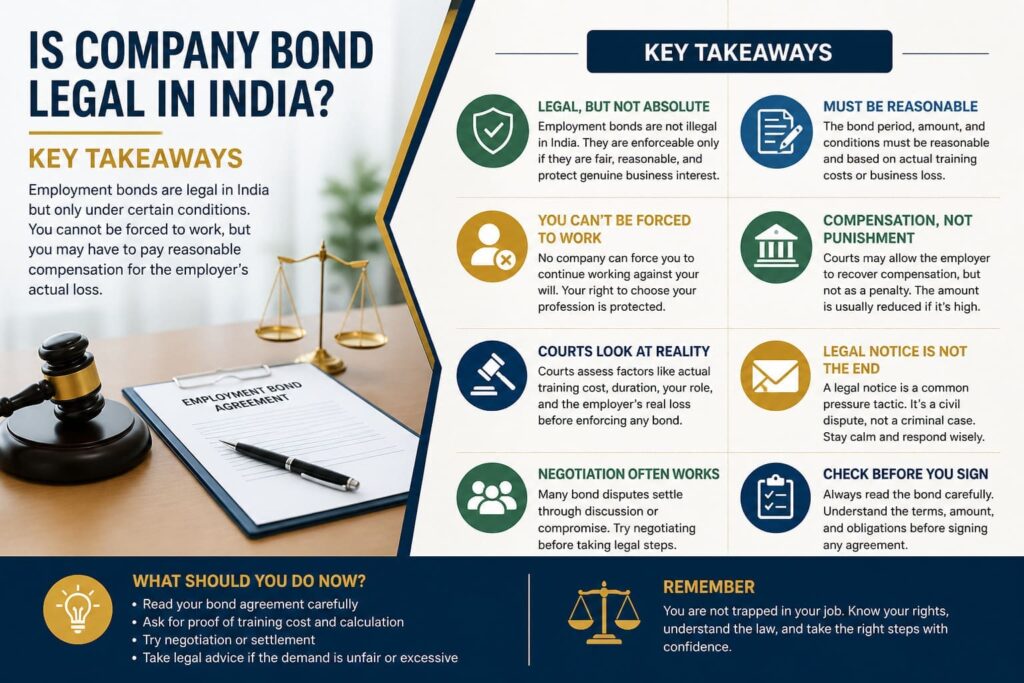
Yes, employment bonds are legal in India, but only under certain conditions.
And no, your company cannot force you to work against your will.
Now let’s break this down in a way that actually helps you decide what to do next.
Why There Is So Much Confusion About “Company Bond”
Before we go deeper, you should know something important.
The term “company bond” is confusing because it can mean two different things:
- Corporate bond (investment product)
- Employment bond (job agreement)
If you are reading this, you are most likely dealing with an employment bond, also called:
- service bond
- job bond
- bond employment contract
This article focuses only on employment bond legality in India.
Is Employment Bond Legal in India? (Simple Answer)
Let’s keep this simple.
An employment bond is not automatically illegal in India.
But it is only enforceable if:
- It is reasonable
- It protects genuine business interest
- It is not unfair or one-sided
Under Indian law:
- You cannot be forced to work
- But you may have to compensate the employer if you leave early
This is why you’ll often see confusion around employment bond validity in India, because every case depends on facts.
When Is an Employment Bond Valid? (Checklist You Can Use)
Instead of theory, let’s use a practical checklist.
Your bond is likely valid if:
- The company invested money in your training, certification, or onboarding
- The bond period is reasonable (usually 1–3 years)
- The amount mentioned is a genuine estimate of loss, not random
- You signed it knowingly and voluntarily
Example:
A company spends ₹1 lakh on your training and asks you to serve 2 years. This is more likely to be considered valid.
Your bond is likely NOT valid if:
- No real training was provided
- The bond amount is very high (e.g., ₹5–10 lakh without justification)
- The bond restricts your ability to work elsewhere
- It feels like pressure or coercion
Example:
A fresher is asked to sign a 3-year bond with ₹3 lakh penalty without any special training—this may not hold strongly in court.
What Happens If You Break an Employment Bond?
This is the most common fear.
Let’s answer it directly.
1. Can the company force you to work?
No.
You are free to leave your job.
2. Can the company take legal action?
Yes, but only civil action (not criminal).
3. Will you have to pay the full bond amount?
Not necessarily.
Courts usually check:
- Actual loss suffered by employer
- Whether the amount is reasonable
Real-life example:
- Bond amount: ₹2,00,000
- Court may reduce it to ₹30,000–₹50,000 based on actual loss

Real-Life Situations (What Actually Happens)
Let’s look at common situations people face.
Situation 1: You signed a 2-year bond but want to leave in 6 months
What happens?
- Company may demand payment
- You can negotiate
- Court will check if the amount is reasonable
You are not “trapped”
Situation 2: Company gave no training but asks for bond money
This is common.
- You can challenge it
- Ask for proof of training cost
- Many such claims fail in court
Situation 3: Employer threatens legal notice
This is often used to scare employees.
Reality:
- It is a civil dispute
- No police case
- No arrest
If you are already dealing with pressure tactics, you may also find it helpful to understand how employers sometimes misuse processes in other areas; for example, in cases like Company Not Giving Relieving Letter? Take Action Before It Affects Your Job.
What Do Courts Actually Look At?
Courts in India don’t blindly enforce employment bonds.
They ask:
- Was the bond reasonable?
- Did the employer suffer real loss?
- Was the agreement fair?
Courts have repeatedly said:
- Bonds cannot create “forced employment”
- Compensation must be reasonable—not punishment
This is why many cases result in reduced payment, not full bond recovery.
Your Rights as an Employee
If you are worried, understand this clearly:
You have the right to:
- Leave your job
- Work anywhere else
- Challenge unfair bond terms
Important points:
- You will not go to jail
- This is not a criminal matter
- Employer cannot block your career
If your employer is also withholding salary or dues along with bond pressure, you should read:
Employer Not Paying Salary? 7 Legal Steps to Recover Your Salary
What Employers Can Legally Do
To be fair, employers also have rights.
A bond becomes enforceable when:
- They genuinely invest in training
- They suffer measurable loss
- They can prove it in court
But even then:
- They cannot impose unfair penalties
- They cannot restrict your career
Valid vs Invalid Bond Clauses (Simple Comparison)
| Situation | Likely Valid | Likely Invalid |
|---|---|---|
| Training provided | Yes | No training |
| Bond duration | 1–2 years | 3–5 years without reason |
| Bond amount | Based on cost | Random high penalty |
| Work restriction | Limited | Full career restriction |
Employee Rights • HR Disputes • Labour Law Guide
Stuck between a new job offer and a long notice period?
Many employees in India face pressure from HR during resignation. Salary deductions, relieving letter delays, notice recovery, and buyout confusion can quickly become stressful. Before taking any emotional decision, understand your legal rights, practical risks, and the proper notice period buyout process.
Learn how notice period buyout works in India, how companies calculate recovery amounts, whether employers can reject your request, and what employees should do to avoid future HR or legal complications.
Common Myths About Employment Bonds
Let’s clear some myths.
“I will go to jail if I break the bond”
False. It’s not a criminal case.
“Company can ruin my career”
False. They cannot legally stop you from working elsewhere.
“I must pay full bond amount”
Not true. Courts often reduce it.
What Should You Do Now? (Step-by-Step Action Plan)
If you are currently dealing with a bond issue, follow this:
Step 1: Read your agreement carefully
Check:
- Bond period
- Amount
- Training clause
Step 2: Ask for justification
Ask employer:
- What training cost was incurred?
- How is the amount calculated?
Step 3: Try negotiation
Most cases settle here.
Step 4: Don’t panic over legal notice
It is a common pressure tactic.
Step 5: Take legal advice if needed
Especially if amount is high
If your issue also involves notice period conflicts, this guide will help you:
Notice Period Buyout in India: Meaning, Rules, Calculation & What You Should Do
Frequently Asked Questions (FAQs)
FAQs on Company & Employment Bonds in India
Click a question to expand the answer. This section covers legality, bond period, and what happens if you break a bond.
Is company bond legal in India?
Yes, but only if it is reasonable, proportionate, and based on genuine business loss.
Is employment bond legal in India?
Yes, employment bonds can be legal, but courts only enforce fair and reasonable terms that are not oppressive.
How many years bond is legal in India?
There is no fixed limit in law, but courts typically consider a bond period of about 1–3 years reasonable, depending on the training and role.
Can I refuse to pay employment bond?
You can dispute or challenge the bond if it is unfair, excessive, or not backed by actual training or business loss.
What happens if I break employment bond?
The company may demand compensation, but a court can reduce the amount and will usually award only proven, reasonable loss.
Is job bond valid in India?
A job bond is valid only if it meets legal conditions such as reasonableness, fairness, and a genuine link to the employer’s actual costs.
Can company take legal action for bond?
Yes, an employer can file a civil case for compensation, but breaking a bond is not a criminal offence by itself.
Final Thoughts (What Really Matters)
If you remember just one thing, remember this:
You are not legally trapped in a job.
An employment bond is not a tool to control you—it is only meant to protect genuine business loss.
And in many real cases, employees either:
- Pay a reduced amount
- Negotiate settlement
- Or walk away without major consequences
Need Help With Your Situation?
If you are facing a real issue like:
- Employer demanding bond payment
- Legal notice received
- Confused about your agreement
You should not guess your next step.
a. Get your bond reviewed properly
b. Understand your actual legal risk
c. Respond correctly before taking action
Because one wrong move (or unnecessary fear) can cost you money or opportunity.