
If you are reading this, there is a high chance you are sitting with a restaurant bill in front of you or you recently paid one and now feel uncomfortable about an extra charge added at the end.
Let’s address your concern directly.
Is service charge mandatory in India?
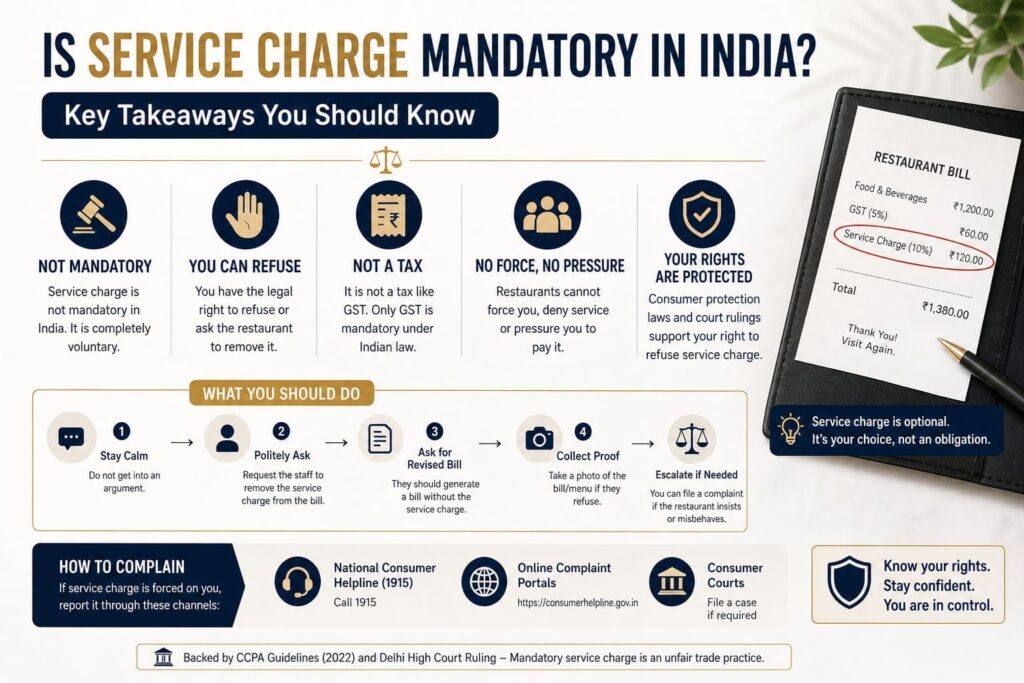
No, service charge is not mandatory in India. You have the legal right to refuse to pay it.
Many people are unsure at this point because the bill looks official, and the staff often says it is “compulsory.” This creates pressure and confusion. You may wonder whether refusing will create trouble or embarrassment. The truth is, the law is on your side.
In India, service charge is treated as a voluntary amount. It is not a government tax like GST. Restaurants may suggest it, but they cannot force you to pay it. If it is added automatically to your bill, you can ask for it to be removed, and they are expected to comply.
Now, instead of just knowing the rule, let’s understand what this means for you in a real-life situation and what exactly you should do when you face this at a restaurant.
Why You Are Seeing Service Charge on Your Bill
Most people face this situation:
You go to a restaurant.
You order food.
The bill comes.
You see:
- Food amount
- GST
- And then an extra 5 percent or 10 percent service charge
When you ask the staff to remove it, they say:
“Sir, this is our policy. It is mandatory.”
This is where confusion starts.
You don’t want to argue.
You don’t want embarrassment.
You just want to pay and leave.
But legally, this is where you need clarity.
What is Service Charge in India?
Service charge is not a tax.
It is:
- Not imposed by the government
- Not compulsory under any law
- Not the same as GST
It is simply a voluntary amount that restaurants may suggest as a tip for their staff.
In simple words:
- GST = Mandatory
- Service charge = Optional
- Tip = Your choice
Many restaurants present it in a way that looks official, which creates confusion for customers.
Is Service Charge Mandatory in India? (Legal Position Explained Simply)
Let’s make this very clear again.
Service charge is not mandatory in India.
This is not just an opinion. It is backed by:
- Government guidelines
- Consumer protection principles
- Court decisions
Authorities have clearly stated:
- Restaurants cannot automatically add service charge
- Customers cannot be forced to pay it
- It must always remain voluntary
If a restaurant insists that you must pay it, that behavior can be treated as an unfair trade practice.
If you want to understand how such practices violate consumer rights more deeply, you can also explore broader protections under Fundamental Rights in India, especially your right to fair treatment.
Can You Refuse to Pay Service Charge in India?
Yes. You can refuse.
This is where most people hesitate.
Let’s break it into real-life behavior:
Situation:
You say, “Please remove the service charge.”
Restaurant replies:
“Sir, it is compulsory.”
What you should know:
- You are within your rights to say no
- You are not breaking any law
- You are not doing anything wrong
What you can say:
“Service charge is optional. Please remove it from my bill.”
Stay calm. No need to argue aggressively.
Can a Restaurant Force You to Pay Service Charge?
No.
A restaurant cannot:
- Force you to pay service charge
- Deny you service because you refused
- Delay your billing intentionally
- Pressure or intimidate you
If any of this happens, it is not just unethical, it may also be legally questionable.
This situation is similar to other rights violations people face in daily life, like when an employer withholds dues. If you have ever dealt with issues like salary not being paid, you will relate to how important it is to assert your rights. You can read more about that here: Employer Not Paying Salary
Service Charge vs GST vs Tip (Important Difference)
Many people pay service charge because they confuse it with GST.
Let’s simplify:
Service Charge
- Optional
- Controlled by restaurant
- Can be refused
GST
- Mandatory
- Government tax
- Must be paid
Tip
- Completely voluntary
- Direct appreciation for service
If you remember just one thing:
You cannot refuse GST, but you can refuse service charge.
What Should You Do If a Restaurant Charges Service Charge?
Let’s talk practical steps.
Step 1: Stay Calm
Do not get aggressive. You don’t need a fight. You need clarity.
Step 2: Politely Ask for Removal
Say:
“Please remove the service charge from the bill.”
Step 3: If They Refuse
Repeat calmly:
“It is optional. I would like it removed.”
Step 4: Ask for Revised Bill
Most restaurants will remove it when you insist calmly.
Step 5: If They Still Refuse
You have two options:
- Pay under protest and keep proof
- Or refuse to pay that portion
Take a photo of:
- Bill
- Menu (if it mentions service charge)
How to Complain Against Service Charge in India
If a restaurant forces you or behaves badly, you can take action.
You can complain through:
- National Consumer Helpline (1915)
- Online complaint portals
- Consumer court
What you should keep:
- Bill copy
- Payment proof
- Any communication
This process is similar to filing other complaints under consumer law. If you are familiar with how legal complaints work, like filing a case when authorities refuse to act, you may find this helpful: FIR in BNSS
The idea is simple:
Document everything and report properly.
What Should You Do Now?
If you are dealing with this issue right now, follow this:
If You Are Still at the Restaurant:
- Do not panic
- Politely refuse service charge
- Ask for corrected bill
If You Already Paid:
- Keep your bill
- File a complaint if needed
If You Feel Pressured:
- Stay calm
- Do not argue emotionally
- Stick to facts
You are legally safe.
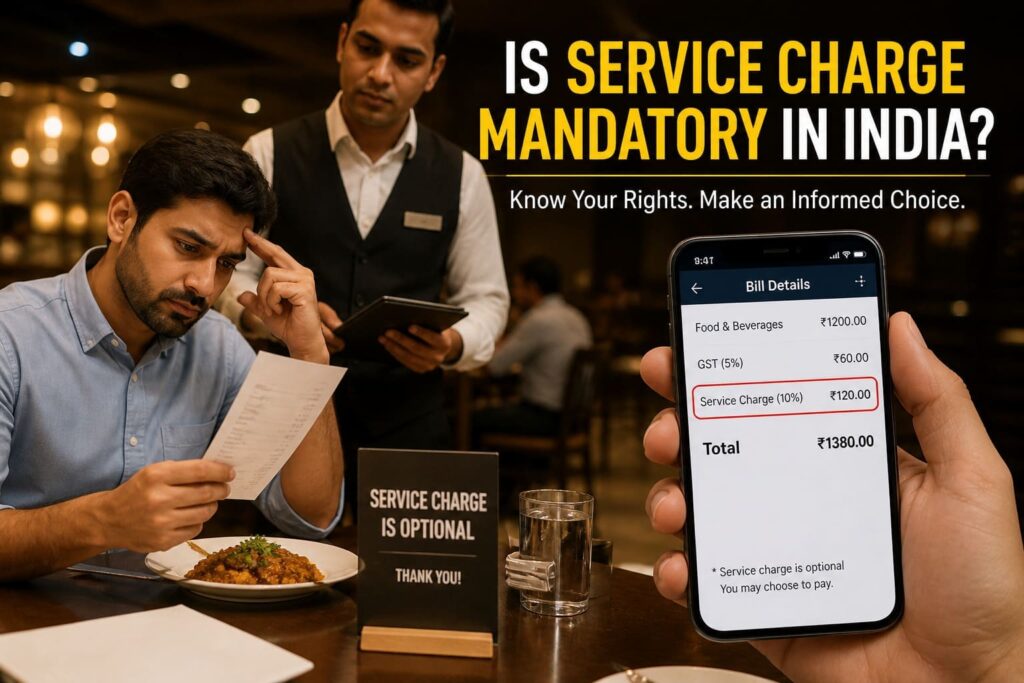
Real-Life Situations and What You Should Do
Situation 1: “This is our policy”
Response:
“Policy cannot override consumer rights. Please remove it.”
Situation 2: Service charge already printed in bill
Response:
“Please generate a revised bill without service charge.”
Situation 3: Group setting and you feel embarrassed
What to do:
- Quietly request removal
- Or pay and complain later
Situation 4: Staff becomes rude
What to do:
- Stay calm
- Do not escalate emotionally
- Collect proof and leave
Why Restaurants Still Charge Service Charge
Even after clear guidelines, many restaurants continue this practice because:
- Customers don’t object
- Lack of awareness
- Social pressure
- Habit
This is similar to how some employers impose unfair conditions until employees push back. If you have ever questioned restrictive policies like job bonds, you will understand this pattern. You can read more here: Company Bond Legal in India
When people start asserting their rights, practices change.
FAQs People Commonly Ask
Service Charge in Indian Restaurants – FAQ (2026)
No. Service charge is not mandatory in India in 2026. It is an optional amount and cannot be imposed on you by default.
No. A restaurant cannot deny you entry or refuse service just because you decline to pay a service charge.
Yes, service charge is legal only when it is voluntary. It becomes a problem under consumer law when it is added or collected compulsorily.
No. Restaurants cannot automatically add a compulsory service charge to your bill. They may mention it as a voluntary charge, but they cannot enforce it if you say no.
Yes. You still have to pay applicable GST on your food and drinks. GST is mandatory under tax law, while service charge is not.
Stay calm and politely repeat that service charge is voluntary and you wish to have it removed. If they refuse, keep the bill and other proof so you can file a consumer complaint later.
No. Simply changing the label (for example, “staff fund” or “facility fee”) does not change the nature of the charge. If it is compulsory and added by default, you can question it.
There is no fixed percentage, because service charge is voluntary. You may choose how much, if anything, you want to pay as a tip or service charge.
Final Advice From a Legal Perspective
You don’t need to be aggressive.
You don’t need to feel guilty.
You don’t need to blindly follow what the restaurant says.
You just need to be informed.
Service charge is your choice, not your obligation.
Need Help With Your Situation?
If you are currently facing this issue or you are unsure how to respond in your specific case:
- Write down your situation
- Keep your bill ready
- Ask your question clearly
Understanding your rights is the first step. Using them correctly is the next.
And once you are aware, no one can pressure you into paying something you are not legally required to pay.
Pingback: Doctrine of Reasonable Classification