
Introduction
If you searched “moonlighting laws in India”, chances are this is not just a random curiosity.
Maybe your company recently sent a strict HR email warning employees against freelancing. Maybe you are working remotely and trying to earn extra income after office hours. Maybe someone in your team got terminated because another employer was discovered through EPFO records. Or maybe you are simply confused because half the internet says moonlighting is illegal while the other half says companies cannot control your personal life.
The reality is more complicated.
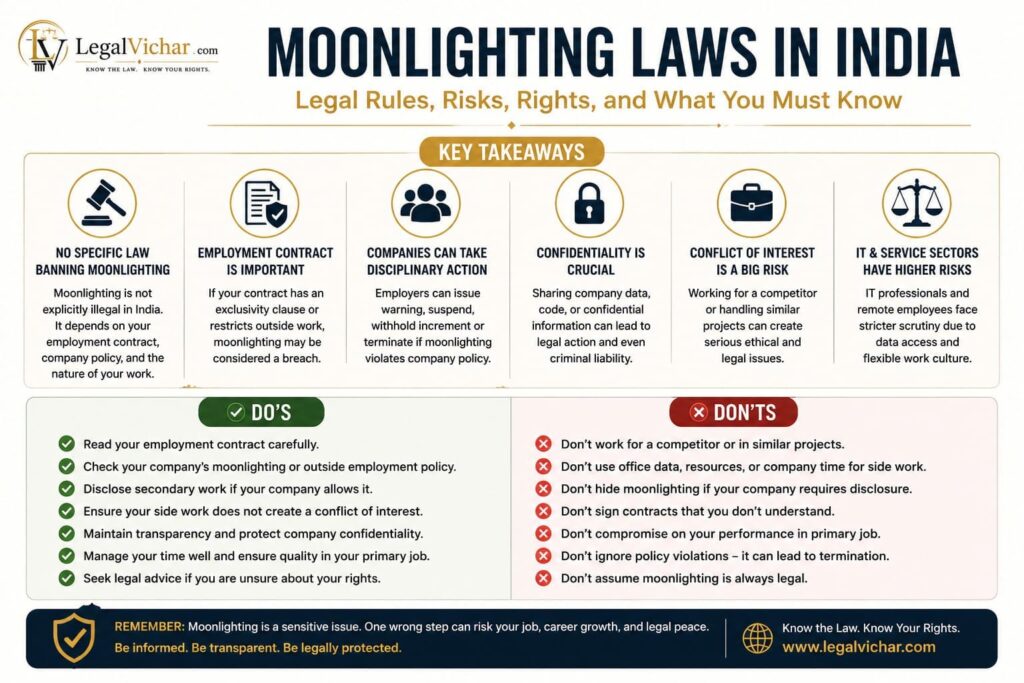
India does not have a single law that directly bans moonlighting for every employee across every sector. But that does not mean employees are always safe doing side work. In many situations, moonlighting becomes a serious employment issue because of confidentiality obligations, conflict of interest, exclusivity clauses, company policies, and industry regulations.
Over the last few years, especially after work from home culture became normal in the IT industry, moonlighting debates exploded across Indian companies. Infosys publicly supported flexible work to some extent while Wipro openly terminated employees for working simultaneously with competitors. HR departments started monitoring UAN activity, background verification became stricter, and many employees quietly started wondering whether freelancing or secondary employment could destroy their careers.
There is also another side to this conversation.
Many Indian employees work under intense financial pressure. Delayed salaries, layoffs, unstable startup jobs, family responsibilities, and rising living costs have pushed professionals toward freelancing, consulting, teaching, content creation, and side businesses.
So where exactly does Indian law stand?
Can a company legally stop you from moonlighting?
Can you be terminated?
Is freelancing considered moonlighting?
Can EPFO expose dual employment?
And perhaps the biggest question:
Is moonlighting actually illegal in India?
This guide breaks down the legal position, practical risks, employer rights, employee protections, labour law implications, and real world consequences around moonlighting in India.

What is Moonlighting?
Moonlighting generally means working for another employer, client, startup, or business while already being employed full time elsewhere.
In corporate settings, moonlighting usually refers to:
- doing freelance work after office hours
- taking a second remote job
- consulting for another company
- running a side business secretly
- working for competitors simultaneously
- accepting paid projects outside regular employment
The term became extremely popular in India after remote work increased during and after the pandemic.
An employee working full time at an IT company while simultaneously developing software for another startup at night would commonly fall under moonlighting.
But not every side activity automatically becomes illegal or unethical.
For example:
- a software engineer teaching coding classes on weekends
- a designer selling templates online
- a lawyer writing independent legal content
- a salaried employee running a YouTube channel
may not necessarily violate the law unless company contracts specifically prohibit such activities.
This distinction matters a lot.
Because in India, moonlighting disputes are usually less about criminal law and more about employment contracts, conflict of interest, productivity concerns, confidentiality obligations, and workplace ethics.
If you are completely new to this concept and still trying to understand how moonlighting actually works in corporate jobs, why companies react so strongly to it, and what usually counts as dual employment in practical situations, you can also read our detailed beginner friendly guide on What is Moonlighting? Is It Legal in India.
Moonlighting Meaning in Corporate Sector
From an employee’s perspective, moonlighting often feels practical.
Extra income. Skill development. Financial safety. Career flexibility.
But companies view it very differently.
Large employers, especially in the IT sector, worry about:
- confidential information leakage
- divided employee attention
- reduced productivity
- cybersecurity risks
- misuse of company resources
- client conflicts
- intellectual property theft
- competitor collaboration
Imagine a developer working for Company A during the day and secretly developing similar software for Company B at night.
Even if no data is directly stolen, companies may still argue there is a conflict of interest.
This becomes even more sensitive in industries like:
- information technology
- fintech
- healthcare
- cybersecurity
- legal consulting
- SaaS businesses
- data processing companies
In these sectors, employee contracts often contain strict confidentiality clauses and exclusivity obligations.
That is why moonlighting conversations are rarely just moral debates. They are deeply tied to employment compliance and commercial risk.
Is Moonlighting Legal in India?
This is where things become legally nuanced.
There is no universal Indian law that directly says:
“Moonlighting is illegal for all employees.”
At the same time, there is no unrestricted legal right allowing every employee to work for multiple employers without consequences.
Whether moonlighting is allowed depends on several factors:
- employment contract terms
- company policy
- nature of secondary work
- industry regulations
- labour laws
- conflict of interest
- confidentiality obligations
- state specific rules
In practical terms, most moonlighting disputes in India are handled through employment agreements rather than criminal prosecution.
For example, many companies include clauses restricting:
- dual employment
- outside consulting
- working with competitors
- disclosure of confidential information
- secondary paid work without approval
If an employee violates those clauses, the company may take disciplinary action.
But that still does not automatically make moonlighting a criminal offence.
This distinction is important because many employees wrongly believe they can be jailed simply for freelancing.
Usually, the bigger risks involve:
- termination
- loss of relieving letter
- employment disputes
- breach of contract allegations
- damaged professional reputation
- legal notices in severe cases
In fact, many employees who get terminated later struggle with relieving letter disputes during future job verification processes. Some employers intentionally delay paperwork once policy violations are alleged. That creates another problem because future companies often ask for relieving documents during onboarding. Situations like these are very similar to the issues discussed in our detailed guide on Company Not Giving Relieving Letter? Take Action Before It Affects Your Job, where many employees get stuck between HR policies and career transitions.
Moonlighting Laws in India
India currently does not have one dedicated “Moonlighting Act.”
Instead, the legal position is derived from labour laws, judicial interpretation, company policies, and contractual obligations.
Some important legal frameworks indirectly connected to moonlighting include:
Factories Act, 1948
Section 60 of the Factories Act restricts certain workers from working in multiple factories on the same day.
However, this law mainly applies to factory workers and industrial establishments. It does not directly govern every IT employee or private sector professional.
Still, companies sometimes use the principle behind dual employment restrictions to justify anti moonlighting policies.
Official Reference Suggestion:
Ministry of Labour and Employment
Industrial Employment Standing Orders Rules
Many organizations classify unauthorized secondary employment as misconduct under internal standing orders.
This gives employers the power to initiate disciplinary proceedings if employees violate company rules.
Again, context matters.
An employee secretly working for a direct competitor creates a much stronger legal problem compared to someone teaching online classes on weekends.
Occupational Safety, Health and Working Conditions Code
India’s newer labour codes also indirectly strengthen employer concerns around excessive working hours, employee welfare, and workplace compliance.
Though these laws do not directly ban freelancing, they influence how companies regulate secondary employment.
Dual Employment vs Moonlighting
People often use these terms interchangeably, but they are not always identical.
| Dual Employment | Moonlighting |
|---|---|
| Usually formal employment with two employers | Can include freelancing or side gigs |
| Often visible through payroll systems | Sometimes hidden |
| Contract conflict is common | Ethical concerns also arise |
| Structured employment relationship | May include consulting or freelance work |
For example:
- a software engineer employed full time by two companies simultaneously may fall under dual employment
- a graphic designer doing occasional freelance logo projects after office hours may still be considered moonlighting but not necessarily dual employment
This distinction becomes important during:
- EPFO verification
- tax filing
- HR background checks
- employment disputes
Is Moonlighting Illegal in India?
Not always.
And this is where many online articles oversimplify the issue.
Moonlighting itself is not automatically illegal under Indian criminal law.
However, it can become legally problematic in situations involving:
- breach of employment contract
- conflict of interest
- data theft
- misuse of confidential information
- intellectual property violations
- fraud
- client diversion
For example:
If an employee uses proprietary source code from one employer while secretly working for another company, the issue may escalate far beyond simple moonlighting.
In serious situations, employers may pursue:
- civil damages
- confidentiality claims
- injunctions
- cyber law complaints
- criminal allegations relating to data theft
But ordinary freelance work or side income activities do not automatically become criminal offences.
That is an important practical difference.
Can Companies Terminate Employees for Moonlighting?
Yes. In many situations, companies can terminate employees for moonlighting, especially if it violates employment contracts or internal policies.
Indian private sector employment is heavily contract driven.
If your agreement contains:
- exclusivity clauses
- conflict of interest restrictions
- disclosure obligations
- non competing employment conditions
then violating those terms may result in disciplinary action.
Large Indian companies have already taken strict action against employees for unauthorized dual employment.
But employers still need to follow reasonable procedures.
Arbitrary termination without documentation can create separate legal disputes.
Interestingly, moonlighting allegations often become more aggressive once employees resign or start serving notice periods. HR departments sometimes investigate secondary employment during background verification or exit clearance. In several cases, employees suddenly face pressure to leave early, hand over projects immediately, or accept uncomfortable exit terms. We have seen similar confusion in notice period disputes covered in Employer Wants Me to Leave Before My Notice Period? 7 Legal Facts You Must Know.
In such situations, notice period disputes also become common.
Employer suddenly asking you to leave before your notice period ends?
Notice period disputes often become more aggressive when employers suspect moonlighting, dual employment, or policy violations. Many employees feel pressured, confused, or even threatened during sudden exits. Before accepting anything blindly, understand your legal rights, salary implications, relieving letter risks, and what Indian employment law actually says in these situations.
Read the Complete Legal GuideSome employers may also delay:
- full and final settlement
- experience letters
- relieving documents
especially if policy violations are alleged.
What is the Punishment for Moonlighting?
There is no fixed nationwide punishment specifically prescribed for moonlighting.
Consequences usually depend on:
- company policy
- employment contract
- severity of misconduct
- industry sensitivity
- whether confidential information was involved
Common consequences may include:
- warning letters
- suspension
- termination
- legal notices
- loss of incentives
- reputational damage
- future employment complications
In severe cases involving data misuse or fraud, additional legal action may arise.
But ordinary freelancing does not automatically lead to criminal prosecution.
That is why employees should avoid panic driven assumptions based on social media discussions.
Can a Company Stop You From Moonlighting?
In many situations, yes.
Companies can legally impose reasonable restrictions through employment contracts, especially where:
- confidential data is involved
- client relationships are sensitive
- competition risks exist
- intellectual property protection matters
However, restrictions still need to be reasonable.
For example, a company may have stronger justification restricting a cybersecurity analyst from secretly working with a direct competitor than preventing an employee from teaching guitar classes on weekends.
Employees should carefully check:
- employment agreements
- HR policies
- confidentiality clauses
- exclusivity provisions
- conflict of interest declarations
before accepting secondary work.
Many employment agreements also contain restrictive obligations similar to employment bond clauses that attempt to regulate employee conduct beyond ordinary working hours. If you have ever signed a restrictive service agreement, the legal principles become quite similar to the situations discussed in Is Company Bond Legal in India? A Practical Guide If You’re Stuck in a Job Bond.
Moonlighting in the Indian IT Industry
The IT sector became the centre of India’s moonlighting debate.
Remote work changed everything.
Employees suddenly had:
- flexible schedules
- reduced supervision
- access to global freelance opportunities
- remote consulting projects
- startup collaborations
At the same time, layoffs and economic uncertainty pushed many professionals toward side income.
But IT companies became increasingly concerned about:
- overlapping projects
- code sharing
- cybersecurity threats
- productivity decline
- client confidentiality
Some companies openly opposed moonlighting.
Others adopted more flexible policies allowing secondary work with disclosure and approval.
This area is still evolving.
The reality is that Indian companies themselves are not fully consistent.
Some tolerate side hustles.
Some prohibit them entirely.
Some ignore them unless performance declines.
Some aggressively investigate dual employment using UAN records and background checks.
A lot of employees still confuse ordinary freelancing, side hustles, and actual dual employment. That confusion became much bigger after remote work culture exploded in India. We discussed some of these practical workplace situations in our earlier article on What is Moonlighting? Is It Legal in India.
Risks of Moonlighting for Employees
Moonlighting is often presented online as an easy side income opportunity.
But many employees underestimate the practical risks.
Potential problems include:
- burnout
- sleep issues
- reduced productivity
- tax complications
- employment disputes
- HR investigations
- career reputation damage
- conflict of interest allegations
- future background verification issues
There is also growing concern around EPFO tracking.
Many employees on Reddit discussions specifically worry about whether dual PF contributions expose secondary employment.
While UAN records do not automatically prove misconduct, they can certainly raise HR questions during verification.
Financial pressure is one of the biggest reasons employees look for secondary income in the first place. Delayed salaries, unstable work conditions, and uncertain employment situations push many professionals toward freelancing or side gigs. In reality, many employees start searching for side income only after facing salary delays or toxic work conditions similar to the situations discussed in Employer Not Paying Salary? 7 Legal Steps to Recover Your Salary.
Risks of Moonlighting for Employers
Companies also face legitimate concerns.
Potential employer risks include:
- confidential data leakage
- intellectual property theft
- cybersecurity vulnerabilities
- employee fatigue
- client diversion
- reduced performance
- misuse of internal systems
- conflict of interest
For industries handling sensitive customer information, even accidental data exposure can become a major compliance issue.
That is why many employers increasingly monitor:
- unusual login patterns
- overlapping work schedules
- external business activities
- LinkedIn profile changes
- freelance marketplace presence
Is Moonlighting Ethical?
This debate has no universally accepted answer.
Employees often argue:
- salaries are insufficient
- skills should not belong entirely to employers
- freelancing improves career growth
- companies themselves prioritize profits
Employers argue:
- employment requires loyalty
- divided attention harms productivity
- confidential information must be protected
- simultaneous work creates trust issues
Honestly, the ethical answer often depends on context.
A developer secretly working for direct competitors creates a very different ethical situation compared to an employee running a weekend photography business.
Blanket answers usually ignore those differences.
How Companies Detect Moonlighting
This is one of the most searched practical questions online.
And yes, companies do investigate moonlighting.
Common detection methods may include:
- EPFO and UAN activity
- LinkedIn profile monitoring
- background verification checks
- overlapping attendance records
- client complaints
- payroll inconsistencies
- employee whistleblowers
- tax related documentation
- unusual work patterns
Many online discussions incorrectly assume companies cannot detect secondary employment.
That assumption is risky.
Several Reddit users specifically discussed concerns around UAN visibility and dual payroll entries.
Still, detection alone does not automatically prove misconduct. Employers usually examine whether:
- company policies were violated
- confidential work was involved
- performance suffered
- conflicts of interest existed
How to Avoid Legal Issues While Moonlighting
Employees considering side work should act carefully.
Some practical precautions include:
- reviewing employment agreements properly
- avoiding direct competitors
- disclosing secondary work where required
- never sharing confidential data
- avoiding use of employer resources
- maintaining performance standards
- separating freelance and office devices
- documenting independent work clearly
Many problems arise not because employees freelance, but because they hide activities that later appear suspicious during HR investigations.
Transparency sometimes prevents much bigger disputes later.
Supreme Court and Judicial Perspective
India still lacks definitive Supreme Court rulings exclusively focused on modern moonlighting culture in IT industries.
However, courts have historically upheld reasonable contractual restrictions relating to:
- confidentiality
- loyalty obligations
- conflict of interest
- competing employment
At the same time, courts also examine whether employer restrictions are excessive or arbitrary.
This balance matters.
Indian employment law generally attempts to balance:
- employer business interests
- employee livelihood rights
- contractual freedom
- fairness principles
That is why moonlighting disputes are rarely black and white.
What Should Employers Include in a Moonlighting Policy?
Companies drafting moonlighting policies usually include:
- disclosure requirements
- approval procedures
- conflict of interest rules
- confidentiality obligations
- disciplinary consequences
- non competing employment restrictions
- intellectual property protections
- cybersecurity expectations
Clear policies actually help both employers and employees.
Ambiguous rules create confusion and inconsistent enforcement.
Sample Moonlighting Policy PDF
Many companies now provide internal moonlighting declaration forms and secondary employment policies.
A proper moonlighting policy usually contains:
- definition of prohibited activities
- approval process
- disclosure obligations
- confidentiality rules
- disciplinary consequences
- examples of conflicts of interest
This section can later include a downloadable policy template for users.
Moonlighting Laws in India FAQs
Employees across India are searching for answers about moonlighting, freelancing, dual employment, EPFO risks, company policies, and termination rules. Here are the most searched practical questions explained in simple language.
Moonlighting generally means working for another employer, client, or business while already employed full time elsewhere.
Moonlighting is not universally illegal in India. Legality depends on employment contracts, company policies, confidentiality obligations, and conflict of interest concerns.
Yes. Companies may terminate employees if secondary employment violates employment agreements or company policies.
Ordinary moonlighting is not automatically a criminal offence. However, issues involving data theft, fraud, or confidentiality breaches may create legal liability.
Multiple PF contributions under one UAN may raise employer questions during verification, though this does not automatically prove misconduct.
It depends on your employment agreement, company policies, and whether the freelance work creates a conflict of interest.
Employers may impose reasonable restrictions through employment contracts, especially where confidential information or competition risks are involved.
In many situations, yes. Paid freelance work outside regular employment may still fall under moonlighting depending on company policy.
Ethical opinions differ. Context matters heavily, especially regarding conflict of interest and employee transparency.
Yes. Termination disputes, policy violations, or dual employment records may create complications during future background checks.
Conclusion
Moonlighting laws in India sit in a grey area between employee freedom and employer protection.
There is no single universal answer that applies to every situation.
A side hustle does not automatically make someone a criminal. At the same time, companies are not powerless when employees secretly violate contracts, misuse confidential data, or work with competitors.
Most moonlighting disputes in India are ultimately about trust.
Trust between:
- employee and employer
- flexibility and accountability
- career growth and contractual responsibility
For employees, blindly assuming “moonlighting is fully legal” can be risky.
For companies, treating every side income activity like corporate espionage is equally unrealistic.
The smarter approach is practical balance.
Clear contracts. Transparent policies. Honest disclosure where required. Reasonable restrictions instead of fear driven reactions.
As remote work, freelancing, and digital careers continue growing in India, moonlighting debates are only going to become more common.
And honestly, Indian employment law is still evolving around this reality.
Pingback: What is Moonlighting? Is It Legal in India (7 Key Facts You Must Know)