
Missing classes in college usually starts as a small issue. A few absences because of illness, long travel, internships, burnout, family pressure, side jobs, or sometimes students simply lose interest in attending lectures regularly. But slowly, for many students in India, attendance problems become much bigger than they initially expected. Internal warnings start coming. Faculty members stop entertaining requests. Exam forms get blocked. Some students suddenly hear that they cannot sit for semester exams anymore. In more serious situations, universities even suspend students, cancel semesters, or force re registration with additional fees.
This is where panic usually begins.
A lot of students start searching questions like, “Can You Get Kicked Out of University for Low Attendance?” because honestly, most students do not fully understand what colleges are legally allowed to do and where student rights actually begin.
The fear becomes even stronger in private universities where disciplinary rules are often stricter and students feel they have very little bargaining power against the administration. Sometimes even one notice from the university is enough to make a student feel like his entire academic future is collapsing.
The practical answer is yes, universities in India can take action for low attendance. But that does not automatically mean every punishment becomes legally fair, reasonable, or unlimited. There is a difference between academic regulation and arbitrary punishment. And that difference matters a lot.
This article explains how attendance rules work in India, when colleges can legally restrict students, when disciplinary action may become excessive, what remedies students practically have, and what mistakes students should avoid if they are already facing attendance related proceedings.
Know Your Constitutional Rights as a Student
Many students believe universities have unlimited power over disciplinary matters. But educational institutions must still operate within broader constitutional principles of fairness, equality, and reasonable treatment.
This article explains how attendance rules work in India, when colleges can legally restrict students, when disciplinary action may become excessive, what practical remedies students have, and what students should avoid doing if they are already facing attendance related proceedings.
What Is the Minimum Attendance Percentage for University in India?
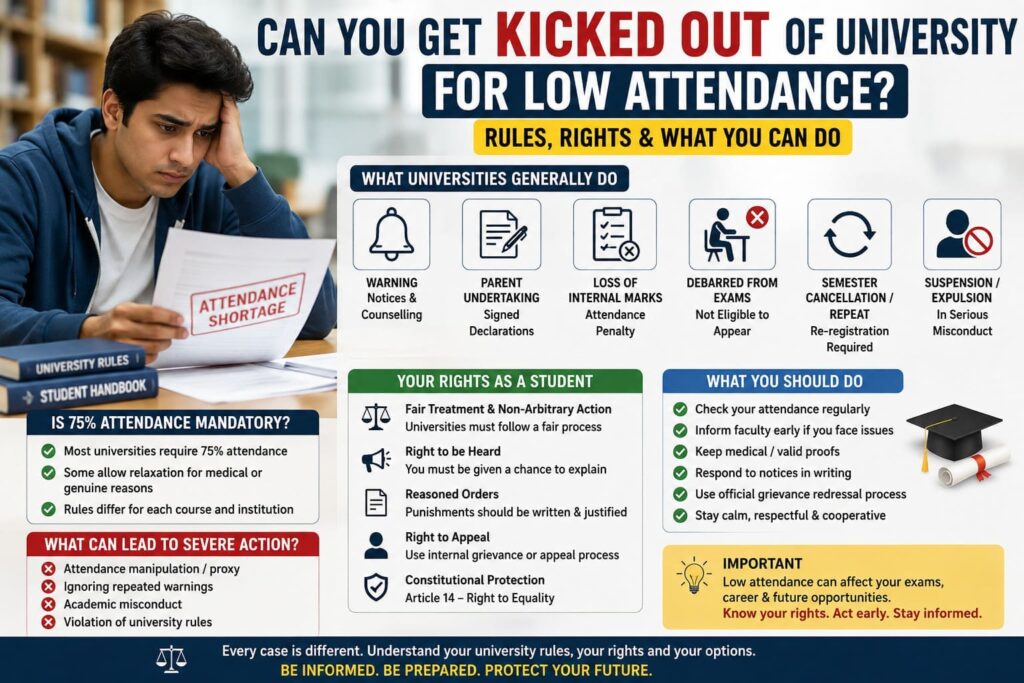
Most universities in India follow a minimum attendance requirement between 75 percent and 80 percent. The exact number depends on:
- UGC guidelines
- University regulations
- AICTE norms for technical institutions
- Medical or professional course requirements
- Internal academic policies
Professional courses such as engineering, law, medicine, pharmacy, nursing, and management programs usually apply attendance rules more strictly than general degree programs.
In many universities, attendance shortages can directly affect:
- Exam eligibility
- Internal assessment marks
- Practical examinations
- Semester registration
- Scholarship continuation
- Hostel permissions
Some universities allow limited relaxation for medical emergencies, sports participation, internships, or exceptional circumstances. However, that relaxation is discretionary and often requires documentary proof.
Students often assume attendance is merely a formality until examination season arrives. That assumption becomes risky because universities increasingly rely on digital attendance systems, biometric records, and ERP portals.
Is 75 Percent Attendance Mandatory or Not?
The answer depends on the institution.
There is no single universal law stating every student in India must maintain exactly 75 percent attendance. However, many universities adopt the 75 percent benchmark through their academic regulations because it aligns with broader educational compliance expectations.
In practical terms, colleges use attendance policies to demonstrate:
- academic discipline,
- classroom participation,
- institutional compliance,
- accreditation quality standards,
- regulatory accountability.
For example, institutions regulated under AICTE or professional councils may face scrutiny regarding teaching hours and classroom engagement. This is one reason attendance enforcement has become stricter over time.
At the same time, attendance rules are not supposed to operate mechanically without considering genuine situations such as:
- serious illness,
- medical treatment,
- disability,
- family emergencies,
- mental health concerns,
- officially approved participation in events.
Where institutions fail to provide any fair hearing or grievance mechanism, disputes sometimes reach High Courts through writ petitions under Article 226 of the Constitution.
Why Is 75 Percent Attendance Compulsory?
From a university’s perspective, attendance is linked to educational quality and institutional credibility.
Universities argue that regular attendance helps ensure:
- continuous learning,
- student engagement,
- practical training participation,
- academic integrity,
- proper use of educational resources.
In courses involving laboratories, clinical training, moot courts, internships, or practical submissions, attendance becomes more than just a classroom requirement.
However, problems usually arise when institutions apply attendance rules without proportionality. A student with slightly low attendance may face the same outcome as someone involved in deliberate attendance fraud or manipulation. That is where disciplinary disputes become more serious.
What Happens If You Have Low Attendance at College?
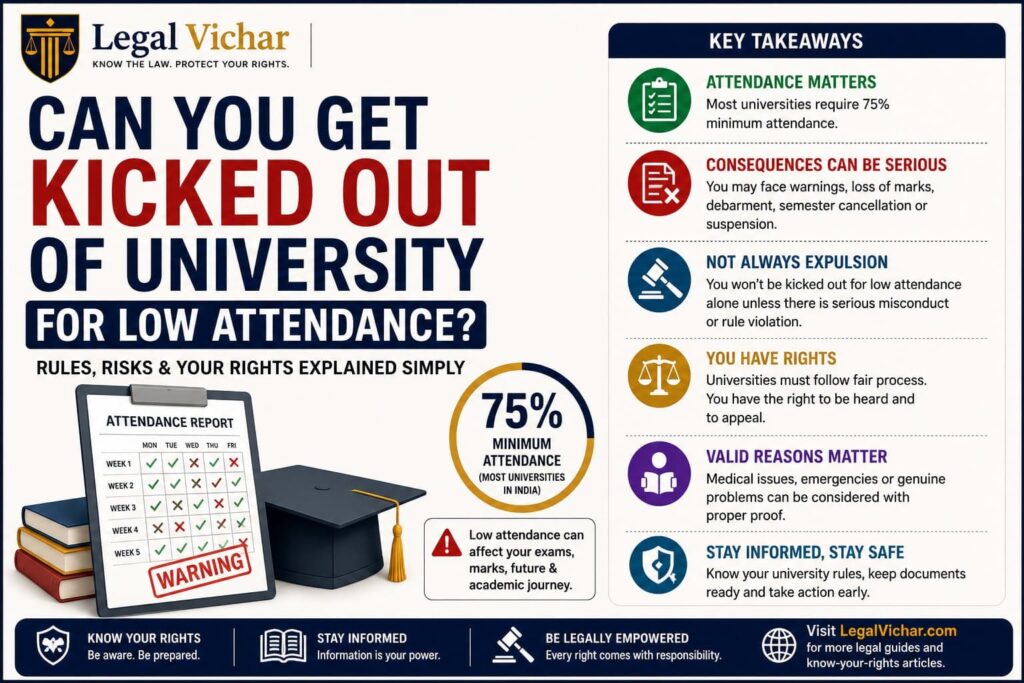
In most Indian universities, low attendance does not immediately lead to expulsion.
Usually, disciplinary action follows stages such as:
Attendance warning notices
Students may receive written warnings, emails, ERP notifications, or calls from faculty members.
Parent undertakings
Some colleges require parents to sign declarations acknowledging attendance shortages.
Restriction from internal assessments
Students may lose marks connected to attendance or classroom participation.
Debarment from semester examinations
This is one of the most common consequences. Students may not be allowed to appear for exams if attendance falls below prescribed limits.
Mandatory re registration
Some universities require students to repeat the semester by paying additional academic fees.
Suspension in serious misconduct cases
Where attendance records are manipulated fraudulently, universities may treat the issue as academic misconduct rather than simple absenteeism.
That distinction is extremely important.
A student who genuinely missed classes due to health or personal reasons is treated differently from someone accused of intentionally manipulating attendance systems.
Can You Get Kicked Out of University for Low Attendance?
Yes, but usually not for ordinary attendance shortage alone.
Permanent expulsion or long term suspension generally happens where low attendance is combined with:
- repeated disciplinary violations,
- document falsification,
- impersonation,
- attendance manipulation,
- examination misconduct,
- fraudulent conduct,
- repeated non compliance despite warnings.
This is why many students misunderstand their situation. They think they are being punished only for attendance shortage, whereas the university may classify the conduct as academic dishonesty.
That classification gives institutions broader disciplinary powers.
Still, even disciplinary authority is not unlimited.
Under principles of natural justice, institutions are generally expected to provide:
- notice of allegations,
- opportunity to respond,
- fair hearing process,
- written disciplinary findings.
Where punishment appears grossly disproportionate, students sometimes challenge disciplinary action legally. Courts usually avoid interfering in academic matters unless there is evidence of:
- procedural unfairness,
- arbitrariness,
- mala fide action,
- violation of institutional regulations,
- denial of hearing,
- irrational punishment.
Can a University Cancel an Entire Semester Due to Attendance Issues?
This is where disputes become emotionally and financially serious.
Semester cancellation affects:
- academic progression,
- placement opportunities,
- education loans,
- mental health,
- family finances,
- future admissions.
Private universities sometimes impose:
- semester cancellation,
- forced semester repetition,
- additional academic fees,
- cancellation of already written exams.
Whether such action is legally sustainable depends on:
- university regulations,
- disciplinary policy,
- nature of misconduct,
- procedural fairness,
- proportionality of punishment.
For example, there is a practical difference between:
- missing classes because of illness,
and - manipulating attendance records to gain exam eligibility.
Universities treat the second situation much more seriously because it affects academic integrity systems.
Still, even in misconduct cases, questions of proportionality can arise. A student may admit wrongdoing but still argue that punishment should remain reformative rather than permanently destructive.
Indian courts have repeatedly recognized that disciplinary action should not become arbitrary merely because an institution has authority.
Where Does Institutional Discretion Cross the Line?
Across India, people increasingly question whether private institutions can impose blanket restrictions or unequal treatment without reasonable justification. Similar debates also arise in housing societies, employment spaces, and educational institutions.
Read: Can Housing Society Refuse Bachelors?Does Attendance Matter in University?
In reality, yes.
Students often hear mixed opinions online about attendance not being important. But practically, attendance can affect much more than exam eligibility.
Good attendance may help with:
- faculty support,
- recommendation letters,
- internship opportunities,
- internal marks,
- project participation,
- academic reputation.
Low attendance, on the other hand, may create indirect consequences even where formal punishment does not happen immediately.
For example, students who remain disconnected from academic systems may struggle with:
- internal submissions,
- attendance monitoring,
- exam form deadlines,
- practical requirements,
- faculty communication.
That said, universities also need to recognize that students today face pressures very different from previous generations.
Long commutes, part time work, financial stress, competitive exams, internships, family responsibilities, and mental health concerns increasingly affect attendance patterns across India.
What Is the Main Reason for Low Attendance Among Students?
Attendance shortage is not always caused by irresponsibility.
In many practical situations, students struggle because of:
Mental health issues
Burnout, anxiety, depression, and academic pressure often reduce classroom engagement.
Financial pressure
Some students work part time jobs or freelance work to support education expenses.
Long distance travel
Daily travel in cities like Mumbai, Delhi, Bengaluru, or Kolkata can consume several hours.
Medical conditions
Chronic illness, injuries, or treatment schedules affect regular attendance.
Academic disengagement
Some students stop attending because they feel disconnected from teaching quality or classroom environment.
Toxic institutional environments
Bullying, harassment, humiliation, or hostile faculty behaviour sometimes contribute to absenteeism.
Universities rarely discuss these realities publicly, but they are extremely common.
Rights Awareness Matters More Than Most Students Realise
Many young people only learn about their legal rights after a serious conflict begins. Understanding procedural rights, institutional limits, and legal protections can help students make smarter decisions during disciplinary situations.
Read: What Are Your Rights During an Arrest?Can Students Appeal Against Suspension or Debarment?
Yes.
Many institutions provide internal grievance or appeal mechanisms.
Students facing severe disciplinary action should usually:
Obtain written orders
Never rely only on verbal communication.
Review university regulations
Many students never read the disciplinary handbook applicable to them.
Submit a written representation
A respectful representation explaining circumstances often works better than emotional confrontation.
Attach supporting documents
Medical certificates, mental health records, family emergency proof, or attendance discrepancies may become relevant.
Request proportional reconsideration
Students can request:
- conditional reinstatement,
- semester retention,
- fee reduction,
- probation based continuation,
- academic rehabilitation measures.
Approach grievance committees
Many universities have internal disciplinary or grievance structures.
Consider legal remedies carefully
Where action appears arbitrary, students sometimes consult education lawyers regarding writ petitions before High Courts.
However, aggressive legal escalation without strategy can backfire practically.
Thinking About Filing a Legal Complaint?
Students sometimes become emotionally overwhelmed during disciplinary disputes and consider police complaints or legal action without understanding the proper legal process. Knowing the difference between complaints, FIRs, and police obligations can prevent costly mistakes.
What Students Should Avoid Doing
Students under pressure sometimes make mistakes that worsen their situation.
Avoid:
Threatening university officials
Allegations, intimidation, or aggressive communication rarely help.
Posting unverified accusations online
Social media allegations without evidence can create legal complications including defamation risks.
Submitting fake medical certificates
This often becomes a separate disciplinary offence.
Manipulating attendance systems
Digital attendance fraud may attract severe institutional consequences.
Ignoring notices
Silence is often interpreted negatively during disciplinary review.
A calm, documented, and respectful approach usually works far better than emotional escalation.
Private Universities and Consumer Rights Angle
Students increasingly question whether educational institutions can be challenged under consumer protection principles.
Historically, courts have taken mixed views on whether education qualifies as a “service” under consumer law. However, disputes involving:
- unfair fee practices,
- misleading representations,
- administrative deficiencies,
- contractual obligations,
sometimes raise broader consumer law concerns.
Private universities also operate within broader regulatory ecosystems involving:
- UGC compliance,
- AICTE approval,
- accreditation standards,
- internal governance obligations.
Where institutions exercise disciplinary power, procedural fairness becomes important not only legally but reputationally.
Can Universities Treat Every Student the Same?
Indian constitutional law recognises that fairness does not always mean identical treatment. Punishment and classification must have a reasonable basis and should not become arbitrary.
Read More About Doctrine of Reasonable ClassificationDigital Attendance Systems and Privacy Concerns
Modern universities increasingly use:
- biometric attendance,
- facial recognition,
- ERP tracking systems,
- RFID attendance,
- mobile app monitoring.
This creates new digital governance concerns involving:
- data accuracy,
- consent,
- attendance record disputes,
- technical errors,
- surveillance concerns.
Students accused of attendance shortage should carefully verify whether attendance records themselves contain discrepancies.
A technical error in ERP systems can sometimes create avoidable disciplinary complications.
Practical Example
Consider two different students:
Student A
Missed classes due to surgery and informed faculty with medical records. Attendance dropped below required percentage.
Student B
Used manipulated attendance entries to become exam eligible.
Both have attendance issues, but legally and ethically the situations are entirely different.
Universities generally have stronger disciplinary justification in Student B’s case because academic dishonesty affects institutional integrity.
This distinction becomes important in any legal or disciplinary analysis.
What Should Students Practically Do If Attendance Is Very Low?
If attendance has already become a serious issue:
- speak with faculty early,
- avoid hiding the problem,
- maintain written communication,
- preserve medical or supporting documents,
- check attendance records regularly,
- understand institutional regulations,
- remain respectful during disciplinary proceedings,
- seek legal advice only where genuinely necessary.
Most importantly, students should avoid assuming that panic or confrontation will solve the issue quickly.
Universities are more likely to reconsider cases where students show accountability, cooperation, and seriousness about academic continuation.
Conclusion
Can you get kicked out of university for low attendance in India?
Yes, disciplinary action for attendance related issues is legally possible. Universities have authority to regulate academic standards and enforce institutional discipline.
But that authority is not absolute.
The real legal question is often not whether punishment can happen, but whether the punishment remains fair, proportionate, and procedurally reasonable in the specific circumstances of the student.
A student who genuinely struggled because of health, financial pressure, or personal difficulties stands in a very different position from someone accused of deliberate academic misconduct.
That distinction matters both legally and practically.
Attendance rules are becoming stricter across India, especially in private and professional institutions. At the same time, educational discipline should ideally aim to correct students rather than permanently destroy academic futures over one incident.
Students facing attendance disputes should approach the situation carefully, calmly, and strategically rather than emotionally. In many cases, respectful representation and proper documentation resolve more problems than confrontation ever does.
Frequently Asked Questions
Attendance Rules and Student Rights
Yes. Universities may suspend or debar students where attendance shortages become severe or involve disciplinary misconduct such as attendance manipulation.
No. Attendance requirements differ between institutions, though many Indian universities follow the 75 percent benchmark.
Yes. Many universities restrict exam eligibility if attendance falls below prescribed limits.
In serious cases involving disciplinary violations or institutional regulations, universities may cancel semesters or require re-registration.
Students may use grievance mechanisms or approach courts where disciplinary action appears arbitrary or violates principles of fairness.
Many institutions provide relaxation for genuine medical situations if proper documentation is submitted.
Yes. Submitting false documents may result in additional disciplinary or legal consequences.