
Introduction
One moment you are driving home from work. The next moment, a vehicle crashes into you and disappears before you can even understand what happened.
No phone number.
No apology.
No help.
Just damage, confusion, and a hundred questions running through your mind.
Many people who face a hit and run case feel helpless. Some suffer serious injuries. Some lose their loved ones. Others spend months trying to recover compensation because the driver who caused the accident simply ran away.
The situation becomes even more stressful when you do not know what the law says, how to file a complaint, or whether you can receive compensation if the driver is never found.
If you searched for “hit run case” or “hit and run case in India”, chances are you are either dealing with such a situation right now or you want to understand your legal rights before something goes wrong.
This guide explains everything in simple language. You will learn what a hit and run case means, which BNS provisions may apply, what punishment a driver can face, how to file an FIR, and what compensation may be available to victims and their families.
What Is a Hit and Run Case?
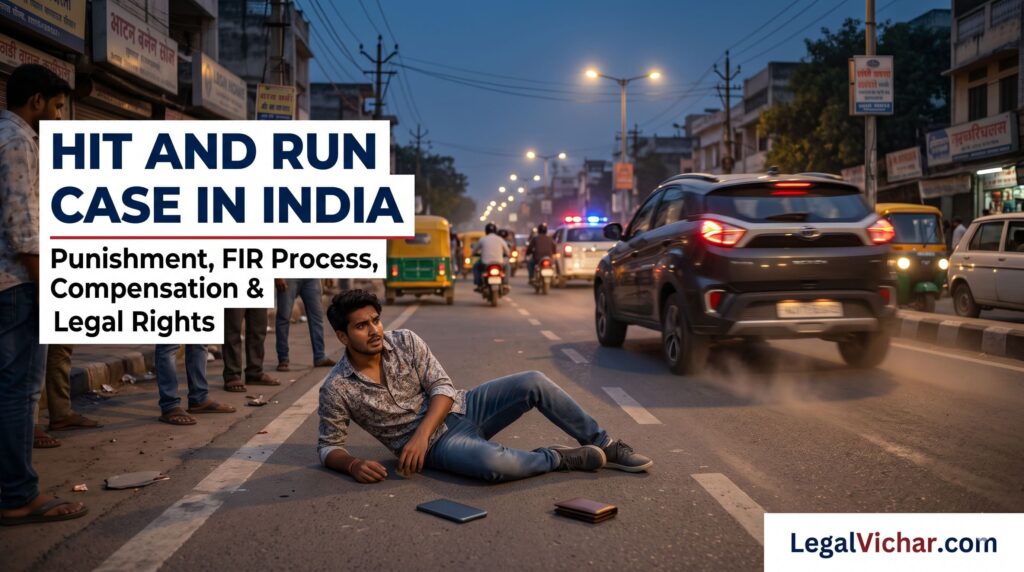
A hit and run case happens when a person driving a vehicle causes an accident and leaves the place without helping the injured person, reporting the accident, or sharing their identity.
The vehicle may be a car, truck, bus, motorcycle, auto rickshaw, or any other motor vehicle.
In simple words, the accident is not the only problem.
The bigger problem is that the driver tries to escape responsibility.
Imagine a motorcyclist gets hit by a speeding car at a traffic signal. Instead of stopping and helping the injured person, the car driver speeds away.
This is a classic example of a hit and run case.
Hit and Run Case Meaning
Many people believe that every road accident automatically becomes a hit and run case.
That is not true.
An accident becomes a hit and run case when the driver:
- Leaves the scene without stopping
- Refuses to help the injured person
- Does not report the accident
- Tries to hide their identity
- Escapes before police arrive
The law expects every driver to act responsibly after an accident.
Running away can make the legal consequences much more serious.
Common Examples of Hit and Run Cases in India
Some common situations include:
- A car hits a pedestrian and drives away.
- A truck collides with a motorcycle and escapes.
- A vehicle damages another parked vehicle and leaves.
- A drunk driver causes an accident and flees.
- A speeding vehicle hits a cyclist and disappears.
These incidents happen every day across India, especially in large cities where traffic is heavy and identification becomes difficult.
Hit and Run Case in India: Legal Framework
Road accidents are governed by several laws in India.
When a hit and run case occurs, authorities may examine provisions under:
- Bharatiya Nyaya Sanhita
- Bharatiya Nagarik Suraksha Sanhita
- Motor Vehicles Act
- Other applicable criminal laws depending on the facts
The exact legal provisions depend on:
- Nature of injuries
- Whether death occurred
- Whether the driver was negligent
- Whether the driver intentionally fled
- Evidence collected during investigation
Why the Law Takes Hit and Run Cases Seriously
The law does not expect drivers to perform miracles after an accident.
However, it expects basic human responsibility.
A person who is injured on the road may require immediate medical treatment.
A delay of even a few minutes can sometimes make the difference between life and death.
When a driver runs away, the victim loses valuable time that could have been used for medical assistance.
That is one of the main reasons why hit and run cases receive serious attention from police and courts.
The Shift From IPC to BNS
India has moved from the Indian Penal Code to the Bharatiya Nyaya Sanhita.
As a result, many legal discussions today focus on BNS provisions rather than IPC provisions.
For ordinary citizens, the important point is simple.
The legal system continues to treat reckless driving, negligence, and abandoning accident victims as serious matters.
Hit and Run Case BNS Section Explained
One of the most common questions people ask is:
“Which BNS section applies to a hit and run case?”
The answer depends on the facts of the case.
There is no single provision that automatically applies to every accident.
Police generally look at factors such as:
- How the accident happened
- Whether negligence was involved
- Whether someone suffered injuries
- Whether someone died
- Whether the driver deliberately fled
Duties of a Driver After an Accident
Every driver has certain responsibilities after an accident.
These responsibilities include:
- Stopping the vehicle
- Checking the condition of injured persons
- Seeking medical help when required
- Cooperating with authorities
- Providing relevant information
When a driver ignores these responsibilities and disappears, the matter becomes much more serious.
Why Leaving the Scene Creates More Problems
Many drivers panic after an accident.
Fear is understandable.
Running away is not.
In many cases, the act of fleeing creates more legal trouble than staying at the scene and cooperating.
Courts often look at post accident behaviour when examining responsibility.
A person who assists the victim and cooperates with authorities is viewed very differently from someone who disappears immediately after causing an accident.
Hit and Run Case Punishment in India
One of the biggest concerns for both victims and accused persons is punishment.
The exact punishment depends on the facts of the case.
No two accidents are identical.
Factors considered may include:
- Severity of injuries
- Death of the victim
- Degree of negligence
- Conduct of the driver
- Evidence available
When Injury Is Caused
If a victim survives but suffers injuries, the investigation generally focuses on how the accident occurred and whether the driver acted negligently.
Police may collect:
- Medical reports
- CCTV footage
- Witness statements
- Vehicle inspection reports
The seriousness of the punishment often depends on the seriousness of the injury.
When Death Occurs
Cases involving death naturally receive much greater scrutiny.
Investigators examine:
- Cause of death
- Circumstances of the accident
- Speed of the vehicle
- Driver behaviour
- Available evidence
Families of victims often pursue both criminal proceedings and compensation claims.
Hit and Run Case Fine
Another common search query is “hit and run case fine”.
Many people assume there is a fixed amount applicable to every case.
In reality, legal consequences can vary depending on the circumstances.
The outcome may be influenced by:
- Nature of harm caused
- Applicable legal provisions
- Findings of the investigation
- Court proceedings
For this reason, it is always advisable to understand the specific facts of the case rather than relying on general assumptions.
What Should You Do Immediately After a Hit and Run Accident?
The first few minutes after a hit and run case are extremely important.
Most people are shocked. Some are injured. Others are angry because the driver has escaped.
In that moment, many people make mistakes that later affect their compensation claim or criminal case.
The priority should always be safety first and legal action second.
Seek Medical Help Immediately
If anyone is injured, call for medical assistance without delay.
Do not waste time chasing the vehicle.
Many accident victims initially believe they are fine, only to discover serious internal injuries later.
Medical records created immediately after the accident often become important evidence during investigation and compensation proceedings.
Try to Remember Vehicle Details
Even small details can help investigators.
Try to note:
- Vehicle registration number
- Vehicle colour
- Vehicle type
- Direction in which the vehicle escaped
- Distinctive marks or stickers
- Approximate speed
Even partial information can sometimes help police identify the vehicle.
Look for Witnesses
Independent witnesses can strengthen a case significantly.
If people nearby saw the accident, politely request their contact details.
Many cases are solved because a witness remembered something important that the victim missed.
Check Nearby CCTV Cameras
Modern investigations rely heavily on CCTV footage.
Look around for:
- Traffic signal cameras
- Shop cameras
- ATM cameras
- Building security cameras
- Parking cameras
Many CCTV recordings are automatically deleted after a certain period.
The earlier the footage is secured, the better.
How to File an FIR in a Hit and Run Case?
One of the biggest mistakes victims make is waiting too long before reporting the incident.
A delayed report can make investigation more difficult.
As soon as possible, approach the nearest police station and provide complete details of the accident.
Information Usually Required
Police may ask for:
- Date and time of accident
- Location of accident
- Details of injuries
- Witness information
- Vehicle information if available
- Photographs and videos
Try to provide accurate information.
If you are unsure about certain details, clearly state that you are not certain rather than making assumptions.
Why FIR Registration Matters
An FIR is often the starting point of a criminal investigation.
Without proper reporting, tracking the offending vehicle becomes much harder.
If you are unfamiliar with the procedure, you may also read (FIR in BNSS: How to File an FIR and Avoid Common Mistakes) to understand the process in greater detail.
What If Police Refuse to Register the FIR?
Unfortunately, some people face another problem after the accident.
The police may hesitate to register the FIR due to lack of information about the vehicle or driver.
Many victims wrongly believe that this means the matter is over.
It is not.
The law provides remedies when an FIR is not registered.
You may approach:
- Senior police officers
- Superintendent of Police
- Appropriate Magistrate
- Other legal authorities depending on the circumstances
If you face this situation, you can refer to (What to Do When Police Refuses to File FIR: Know Your Rights and Next Steps) for a detailed explanation of available remedies.
Do not assume that a case cannot proceed simply because the driver has not yet been identified.
How Is a Hit and Run Case Investigated?
Many people think police cannot solve a hit and run case if the driver escapes.
That is not always true.
Modern investigations often rely on multiple sources of evidence.
CCTV Analysis
Investigators frequently review footage from nearby cameras.
A vehicle may appear on several cameras across different roads.
This can help establish:
- Vehicle route
- Vehicle number
- Driver identity
- Time of movement
Witness Statements
Witnesses often provide information about:
- Vehicle colour
- Speed
- Driver behaviour
- Direction of escape
Even seemingly minor details can become important later.
Forensic Examination
In serious cases, forensic experts may examine:
- Vehicle fragments
- Paint transfer
- Tyre marks
- Impact patterns
These findings can sometimes connect a suspect vehicle to the accident.
Mobile and Digital Evidence
Modern investigations increasingly use digital evidence such as:
- Mobile phone location data
- Toll booth records
- GPS records
- Traffic monitoring systems
Technology has made it much harder for offenders to remain unidentified.
FIR and Complaint Are Not the Same
Many people use the terms FIR and complaint as if they mean the same thing.
They do not.
An FIR usually triggers a formal criminal investigation, whereas a complaint may not always result in the same legal consequences.
If you want to understand the distinction, read (Difference Between FIR and Complaint: 7 Key Differences You Must Know).
Hit and Run Case Compensation Amount
One of the first questions accident victims ask is:
“Will I receive compensation if the driver is never found?”
The answer is often yes, depending on the facts and applicable legal provisions.
The purpose of compensation is to help victims and their families recover financial losses caused by the accident.
Compensation in Case of Injury
Compensation may take into account:
- Medical expenses
- Future treatment costs
- Loss of income
- Disability
- Pain and suffering
The exact amount varies from case to case.
Compensation in Case of Death
When a person dies in a hit and run case, family members may be entitled to compensation under applicable laws and schemes.
Authorities may consider:
- Age of the deceased
- Income level
- Number of dependents
- Circumstances of the accident
Why Documentation Is Important
Many compensation claims fail because victims do not preserve evidence.
Always keep:
- Medical records
- Bills and receipts
- Police documents
- Photographs
- Witness details
Good documentation often makes the compensation process smoother.
Insurance Claims After a Hit and Run Accident
Many people assume insurance is useless if the driver cannot be found.
That is not always true.
Depending on the policy and circumstances, insurance coverage may still provide relief.
Own Damage Claims
If your vehicle has appropriate coverage, you may be able to seek compensation for vehicle damage.
The insurer may request:
- FIR copy
- Claim form
- Vehicle inspection
- Repair estimates
Third Party Issues
Third party claims can become more complicated when the offending vehicle remains unidentified.
Each case depends on its facts and applicable insurance provisions.
Common Reasons Claims Get Rejected
Some claims are rejected because:
- The accident was reported late.
- Evidence is insufficient.
- Required documents are missing.
- Policy conditions were violated.
Prompt reporting can help avoid unnecessary complications.
Rights of Victims in a Hit and Run Case
Many accident victims focus only on punishment.
Their rights are equally important.
Right to Medical Treatment
Every injured person deserves timely medical assistance.
Saving a life should always be the first priority.
Right to Report the Offence
Victims have the right to approach law enforcement authorities and seek investigation.
Right to Compensation
Victims and their families may be entitled to compensation depending on the facts of the case.
Right to Legal Representation
Victims can seek legal advice and representation whenever necessary.
Understanding your rights often helps reduce confusion during an already stressful period.
Can a False Hit and Run Case Be Filed?
Most hit and run complaints are genuine.
However, there are situations where false allegations are made.
For example, a vehicle owner may be wrongly accused because someone noted the wrong registration number.
A false accusation can create serious legal consequences for an innocent person.
What Should You Do If You Are Falsely Accused?
If you believe a false case has been filed against you:
- Preserve evidence
- Collect CCTV footage
- Maintain travel records
- Cooperate with investigation
- Seek legal advice
False criminal allegations can themselves attract legal consequences.
To understand this topic further, you may read (False FIR Punishment in India: 7 Years Jail? Know Your Rights for 2026).
Famous Hit and Run Cases in India
Sometimes, understanding real cases helps people understand how seriously the law treats road accidents.
Several hit and run cases have attracted national attention over the years because they involved deaths, serious injuries, lengthy investigations, and public outrage.
Salman Khan Hit and Run Case
One of the most discussed cases in India involved actor Salman Khan. The case attracted nationwide media attention and remained in the public eye for years.
The matter highlighted several important legal questions regarding evidence, witness testimony, driver responsibility, and criminal liability after a road accident.
Even today, many people search for this case while trying to understand how Indian courts deal with hit and run allegations.
BMW Hit and Run Case
The BMW case is another well known example that is frequently discussed in legal circles.
The incident resulted in multiple deaths and became one of India’s most talked about road accident cases.
The case demonstrated how forensic evidence, witness testimony, and police investigation can play a critical role in determining responsibility.
Why These Cases Matter
These cases remind drivers that:
- Road accidents can have lifelong consequences.
- Escaping from the scene often creates additional legal problems.
- Evidence can surface even after significant delays.
- Courts examine not only the accident but also the conduct of the accused after the incident.
For ordinary citizens, the lesson is simple. If an accident occurs, acting responsibly is always better than trying to flee.
Frequently Asked Questions
Everything you need to know about hit and run cases in India, including FIR registration, compensation, investigation, and legal rights.
What is a hit and run case?
Is a hit and run case a criminal offence in India?
What should I do immediately after a hit and run accident?
Can I get compensation if the driver is not found?
How long does a hit and run investigation take?
Can CCTV footage help in a hit and run case?
What happens if someone dies in a hit and run accident?
Is it necessary to file an FIR in a hit and run case?
Can a hit and run case be settled privately?
What if I have been falsely accused in a hit and run case?
Conclusion
A hit and run case is not just a traffic issue.
For the victim, it can be one of the most frightening experiences of their life.
One moment everything is normal. The next moment there is an accident, confusion, medical bills, police procedures, and uncertainty about whether the person responsible will ever be found.
The good news is that the law does not leave victims without protection.
Whether you are dealing with injuries, property damage, loss of a loved one, or difficulties in getting an FIR registered, there are legal remedies available. The most important thing is to act quickly, preserve evidence, seek medical treatment, and report the matter without unnecessary delay.
If you become a victim of a hit and run case, remember that every detail matters. A witness statement, a CCTV recording, a vehicle number noted by a passerby, or a timely FIR can significantly strengthen your case.
At the same time, drivers should remember that panic is never a defence. Leaving an accident scene may turn a difficult situation into a much more serious legal problem. Cooperating with authorities and helping injured persons is not only a legal responsibility but also a moral one.
Understanding your rights is the first step toward protecting them. The more informed you are, the better prepared you will be to handle the legal and practical challenges that often follow a hit and run accident.