
Imagine receiving 20 calls a day from unknown numbers. Your phone rings during office hours, while having dinner with your family, and even early in the morning. Then the calls start reaching your relatives. Your spouse gets questioned. Your parents are contacted. Someone threatens to visit your home if you do not pay immediately.
For many borrowers in India, this is not just an inconvenience. It is a deeply stressful experience that affects mental health, family relationships, professional life, and personal dignity.
While lenders have a legal right to recover legitimate dues, they do not have a right to intimidate, humiliate, threaten, or harass borrowers. Unfortunately, many people are unaware of their rights and continue to suffer in silence.
This article explains everything you need to know about loan recovery agent harassment, the rights available to borrowers, the Reserve Bank of India guidelines governing recovery practices, and the legal remedies available when harassment from loan recovery crosses the line.
Whether you have defaulted on a personal loan, credit card debt, business loan, or are simply facing repeated recovery calls, understanding the law can help you protect yourself and your family.
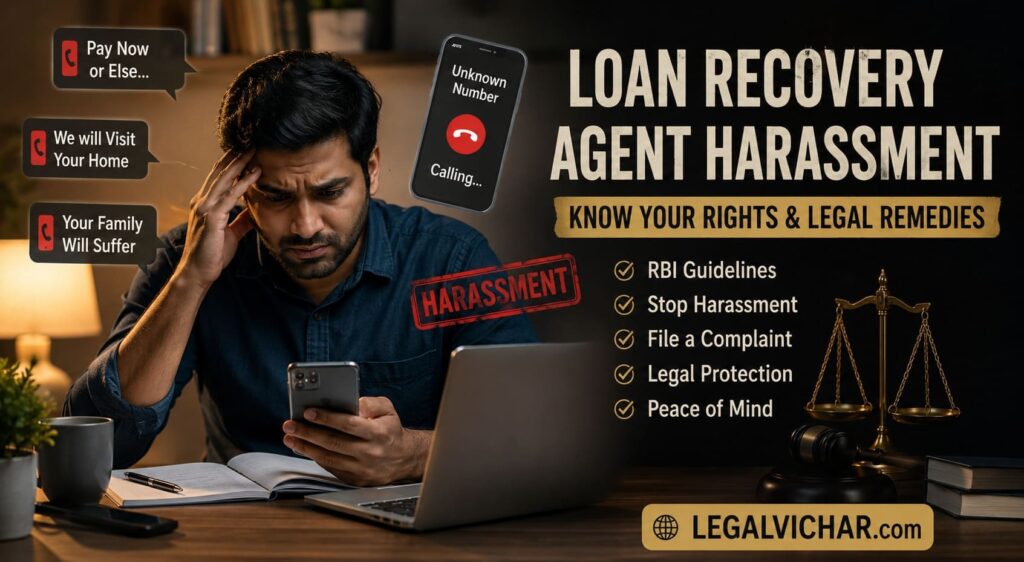
What Is Loan Recovery Agent Harassment?
Before discussing legal remedies, it is important to understand what actually amounts to loan recovery agent harassment.
Recovery agents are appointed by banks, NBFCs, and financial institutions to collect overdue payments from borrowers. Recovery itself is legal. Harassment is not.
A common misconception is that once a borrower defaults, the lender can use any method necessary to recover money. This is completely incorrect.
Loan recovery becomes harassment when recovery agents engage in conduct intended to threaten, shame, intimidate, or mentally pressure a borrower beyond lawful recovery practices.
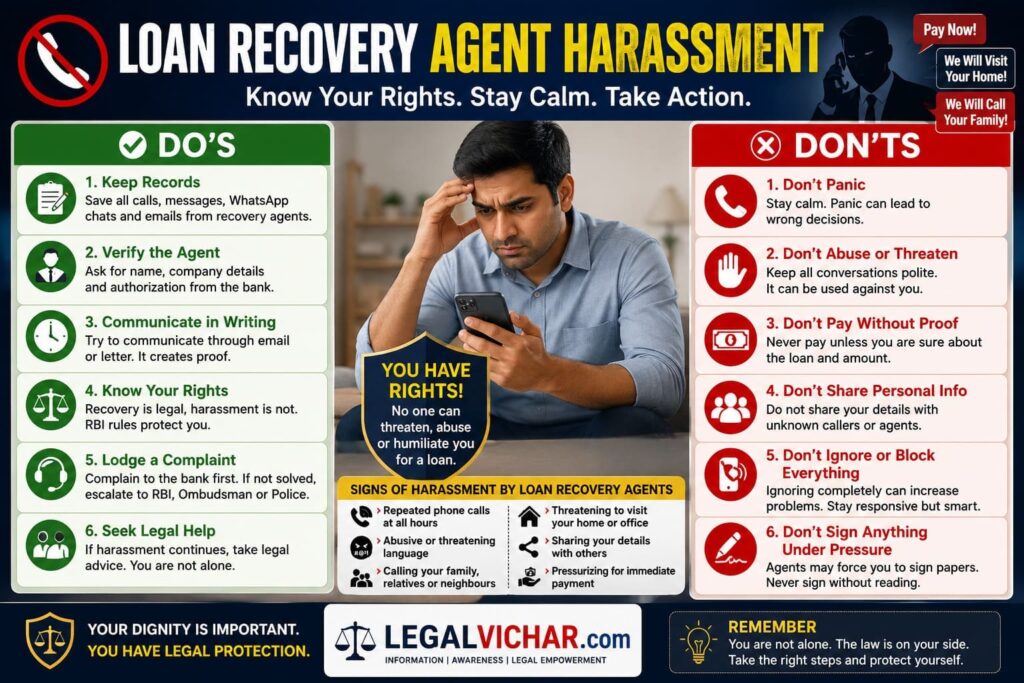
Some common signs of harassment by loan recovery agents include:
- Repeated calls throughout the day
- Calls made at odd hours
- Verbal abuse or threatening language
- Public humiliation
- Contacting family members without necessity
- Contacting employers or colleagues
- Visiting the workplace to create embarrassment
- Threatening arrest without legal authority
- Using social media to shame borrowers
- Sending intimidating messages on WhatsApp
- Threatening physical harm
Many victims of loan recovery agent harassment believe they have no choice but to tolerate such conduct because they owe money. The law says otherwise.
Even when a borrower has defaulted, lenders must follow legal procedures.
Is Harassment During Loan Recovery Legal in India?
The simple answer is no.
Harassment from loan recovery is not legal in India.
The legal system recognizes a distinction between lawful debt collection and unlawful intimidation.
A bank may:
- Demand repayment
- Send reminders
- Issue notices
- Appoint authorized recovery agents
- Initiate legal proceedings
- Approach courts or tribunals
However, a bank cannot:
- Threaten violence
- Abuse borrowers
- Defame borrowers
- Force entry into homes
- Publicly shame borrowers
- Use coercive tactics
Many borrowers ask:
“Is harassment legal during loan recovery in India?”
The answer remains the same regardless of the size of the debt. Recovery is legal. Harassment is not.
In serious cases, aggressive conduct may attract civil liability and even criminal consequences under Indian law.
When harassment from loan recovery causes fear, emotional distress, intimidation, or reputational damage, legal remedies become available.
This distinction is extremely important because many borrowers wrongly assume that defaulting on a loan automatically removes their legal protections.
It does not.
Reserve Bank of India Guidelines on Loan Recovery
The Reserve Bank of India has repeatedly emphasized that financial institutions must adopt fair recovery practices.
The Reserve Bank of India guidelines are designed to protect borrowers from abusive collection methods while allowing lenders to recover legitimate dues.
The RBI requires banks and NBFCs to ensure that recovery agents maintain professionalism and dignity during the recovery process.
Some key principles include:
Respect for Borrower Dignity
Borrowers must be treated with respect and courtesy.
Even if the borrower has defaulted, recovery agents cannot engage in humiliation or intimidation.
Reasonable Contact Hours
Recovery agents should contact borrowers only during reasonable hours.
Continuous calling throughout the day may amount to loan recovery agent harassment.
No Threats or Coercion
The Reserve Bank of India guidelines prohibit:
- Intimidation
- Verbal abuse
- Physical threats
- Public humiliation
Proper Identification
Recovery agents must identify themselves and disclose the institution they represent.
Borrowers have the right to know who is contacting them and why.
Accountability of Banks
Banks remain responsible for the actions of their recovery agents.
A financial institution cannot escape liability by blaming an outsourced recovery agency.
This is particularly important because many complaints of loan recovery agent harassment arise from third party collection agencies acting on behalf of lenders.
What Are Borrower Rights Against Aggressive Debt Collection?
Every borrower in India has legal rights, regardless of their repayment status.
Many people search for information about borrower rights against aggressive debt collection because they feel trapped after missing a few EMIs.
The law does not permit recovery agents to treat borrowers as criminals.
Your rights include:
Right to Privacy
A recovery agent cannot unnecessarily disclose your financial situation to others.
Repeatedly informing neighbours, colleagues, or distant relatives may amount to unlawful conduct.
Right to Dignity
Every individual has a right to be treated with dignity.
Humiliation is not an accepted recovery method.
Right to Seek Legal Remedy
Victims of loan recovery agent harassment can:
- File complaints
- Approach regulatory authorities
- Initiate legal proceedings
- Seek police intervention in serious cases
Right Against Criminal Intimidation
Threats of violence, unlawful detention, or fabricated criminal consequences may constitute criminal offences.
Right to Challenge Incorrect Recovery Demands
Sometimes borrowers are wrongly targeted due to accounting errors or disputed dues.
In such situations, recovery efforts can be challenged through appropriate legal channels.
Can Loan Recovery Agents Contact Borrowers Repeatedly Without Consent?
One of the most common complaints involves repeated phone calls.
Many borrowers receive dozens of calls every day from different numbers.
This raises an important question:
Can loan recovery agents contact borrowers repeatedly without consent?
The answer depends on the nature and frequency of the communication.
A lender may contact a borrower regarding repayment.
However, repeated and excessive calling designed to create mental pressure can become loan recovery agent harassment.
Consider the following situations:
Acceptable Conduct
- Occasional repayment reminders
- Follow up calls during reasonable hours
- Communication regarding restructuring options
Potentially Harassing Conduct
- Calling every hour
- Calling from multiple numbers
- Calling after requests to communicate through email
- Calling late at night
- Calling repeatedly despite ongoing dispute resolution
Harassment from loan recovery often begins with excessive calling and gradually escalates into intimidation.
If you are receiving constant calls, maintain a record of:
- Call logs
- Recordings where legally permissible
- Messages
- WhatsApp communications
- Email correspondence
Such evidence can be valuable if a complaint becomes necessary.
What Actions Constitute Harassment by a Bank or NBFC?
Not every recovery effort amounts to harassment.
However, certain actions clearly cross legal boundaries.
Examples include:
Verbal Abuse
Using insulting language or personal attacks.
Threatening Arrest
Recovery agents generally do not have authority to arrest anyone.
Threatening immediate arrest merely to create fear may amount to intimidation.
Public Shaming
Publishing photographs, disclosing debts publicly, or embarrassing borrowers in front of family members can constitute unlawful conduct.
Workplace Harassment
Repeated visits to a borrower’s workplace with the intention of causing embarrassment.
Contacting Third Parties Excessively
While limited contact for locating a borrower may sometimes occur, repeated communication with unrelated third parties can become problematic.
Psychological Pressure
Many cases of loan recovery agent harassment involve deliberate emotional pressure rather than direct threats.
Statements such as:
“You will lose everything.”
“Your family will suffer.”
“Your reputation will be destroyed.”
may amount to coercive recovery tactics depending on the circumstances.
Why Loan Recovery Harassment Is More Serious Than Most People Realize
The impact of harassment from loan recovery extends far beyond financial stress.
Many borrowers experience:
- Anxiety
- Sleep disturbances
- Depression
- Family conflict
- Reduced workplace productivity
- Social isolation
In some cases, borrowers become afraid to answer phone calls altogether.
The consequences can be devastating.
The law recognizes that financial recovery cannot come at the cost of a person’s dignity and mental well being.
This principle becomes even more important when vulnerable individuals, senior citizens, homemakers, students, or family members who never borrowed money begin facing pressure because of someone else’s debt.
The next question then becomes even more important:
Can recovery agents contact family members, visit your home, call your employer, or pressure relatives into paying?
We will examine these issues in detail, along with complaint procedures, legal remedies, and liability of family members in the next part of this guide.
Can Debt Collectors Contact Family Members in India?
This is one of the most searched questions by borrowers and their families.
The reason is simple.
In many cases of loan recovery agent harassment, the borrower is not the only person receiving calls. Parents, spouses, siblings, friends, neighbours, and even office colleagues suddenly start receiving calls from recovery agents.
Naturally, people become worried.
Can debt collectors contact family members in India?
The answer depends on the circumstances.
If a lender genuinely cannot locate a borrower, a limited inquiry may be made to obtain contact information. However, repeated communication with family members, discussing the borrower’s debt, threatening relatives, or pressuring family members to pay can cross legal boundaries.
For example:
A son takes a personal loan and defaults.
The bank repeatedly calls his elderly parents and tells them:
“Your son is not paying. You must pay.”
This can become problematic if the parents are neither co-borrowers nor guarantors.
Similarly, if a recovery agent calls a borrower’s spouse every day and threatens legal action despite knowing the spouse is not responsible for the debt, such conduct may amount to loan recovery agent harassment.
Many people do not realize this, but family members are not automatically liable for a borrower’s loan.
Legal liability depends on:
- Whether they are co-borrowers
- Whether they signed as guarantors
- Whether they inherited assets after death
- Whether specific contractual obligations exist
Simply being a family member does not create liability.
Can Bank Recovery Agents Come to Your Home?
A very common fear among borrowers is:
“Can bank recovery agents come to my home?”
Yes, recovery agents may visit a borrower’s residence for lawful recovery purposes.
However, there are important restrictions.
A recovery visit does not mean:
- Forced entry
- Threats
- Intimidation
- Abuse
- Property seizure without legal authority
A recovery agent cannot behave like a police officer or court official.
In many complaints involving loan recovery agent harassment, borrowers report that agents attempt to create panic by arriving in groups or speaking aggressively in front of family members.
Such behaviour can become unlawful.
If a recovery agent visits your home:
- Ask for identification
- Ask which institution they represent
- Remain calm
- Avoid arguments
- Record details of the interaction
Remember, a home visit does not give a recovery agent unlimited powers.
Can Recovery Agents Visit on Sundays?
Many borrowers ask:
Can bank recovery agents call on Sunday?
Can they visit on holidays?
The Reserve Bank of India guidelines emphasize reasonable conduct and reasonable contact hours.
Repeated calls during inappropriate times, late nights, or excessive communication during holidays may strengthen allegations of loan recovery agent harassment.
Each situation must be examined based on its facts, but borrowers should not feel that they are available for recovery communication 24 hours a day.
Loan App Recovery Agent Harassment: A Growing Problem in India
The nature of debt recovery has changed significantly in recent years.
Traditional bank recovery is no longer the only concern.
Digital lending apps have created a new category of complaints involving severe loan recovery agent harassment.
Many borrowers report:
- Threatening WhatsApp messages
- Morphed photographs
- Calls to entire contact lists
- Public shaming tactics
- Social media intimidation
Some lending apps improperly access contact information and use it to pressure borrowers.
This type of harassment from loan recovery can be particularly damaging because it targets a person’s reputation.
Imagine your relatives receiving messages suggesting you are a fraudster simply because you missed a repayment.
The emotional impact can be devastating.
The Reserve Bank of India has repeatedly stressed that digital lending platforms must follow lawful recovery practices and maintain borrower dignity.
No lender, whether traditional or digital, has the right to engage in public humiliation.
How to Deal With Recovery Agents in India
When people face loan recovery agent harassment, they often react emotionally.
Some stop answering calls.
Others become aggressive.
Some panic and agree to unrealistic repayment arrangements.
A better approach is to remain calm and strategic.
Step 1: Verify the Debt
Confirm:
- Outstanding amount
- Interest calculation
- Default details
- Identity of the lender
Mistakes sometimes occur.
Step 2: Request Written Communication
Whenever possible, ask the lender to communicate through email or official notices.
Written communication creates a record.
Step 3: Maintain Evidence
Preserve:
- Call recordings
- Call logs
- Text messages
- WhatsApp chats
- Emails
Evidence is extremely important when proving loan recovery agent harassment.
Step 4: Avoid Verbal Confrontation
Do not abuse recovery agents.
Do not threaten them.
Maintain professionalism.
Step 5: Explore Settlement Options
In genuine financial hardship situations, lenders may offer:
- Restructuring
- Settlement
- Revised repayment schedules
Open communication often prevents disputes from escalating.
What Steps Can You Take to Stop Harassment From Loan Collectors?
Many borrowers reach a stage where they ask:
“How do I stop this?”
If you are facing persistent loan recovery agent harassment, consider the following steps.
Send a Written Complaint
Write to:
- The bank
- The NBFC
- The grievance officer
Explain the conduct that is causing concern.
Demand Compliance With RBI Guidelines
Mention the Reserve Bank of India guidelines regarding fair recovery practices.
Financial institutions take written complaints more seriously than verbal objections.
Preserve Evidence
This cannot be stressed enough.
Without evidence, complaints become difficult to prove.
Escalate Internally
Most banks have escalation channels and nodal officers.
Use them.
Seek Legal Advice
In serious cases involving threats or intimidation, professional legal assistance may become necessary.
How to Report Illegal Loan Recovery Practices
Borrowers frequently ask:
How to report illegal loan recovery practices?
The process is generally straightforward.
Step 1: File a Complaint With the Lender
Always begin with the financial institution.
Provide:
- Dates
- Times
- Names
- Phone numbers
- Copies of messages
Step 2: Approach Regulatory Authorities
If the lender fails to address the issue, escalation options become available.
Step 3: Consider Consumer Remedies
Where harassment causes loss, mental agony, or unfair treatment, consumer remedies may be available.
Step 4: Police Intervention in Serious Cases
Where threats, intimidation, extortion, stalking, or criminal conduct are involved, police intervention may be appropriate.
If the police refuse to register your complaint, you may find useful guidance in What to Do When Police Refuses to File FIR.
Similarly, understanding the legal distinction between complaints and FIRs becomes important. You may refer to Difference Between FIR and Complaint for a detailed explanation.
How to File a Complaint Against Harassment by Loan Recovery Agents
Victims of loan recovery agent harassment often hesitate because they believe banks will automatically support recovery agents.
This is not always true.
Most regulated institutions take serious complaints seriously because recovery misconduct creates legal and reputational risks.
When filing a complaint:
Include:
- Date and time of incidents
- Agent details
- Call recordings
- Screenshots
- Witness details
Describe the conduct clearly.
Avoid emotional exaggeration.
Focus on facts.
For example:
Instead of saying:
“They tortured me.”
Say:
“The recovery agent called 17 times between 8:00 AM and 11:00 AM and threatened to contact my employer.”
Specific facts are far more persuasive.
Where Can I File a Complaint Against a Recovery Agent?
Several options may be available depending on the circumstances.
Bank Grievance Redressal Mechanism
The first level is usually the lender itself.
RBI Complaint Mechanism
Borrowers may escalate complaints where regulatory violations are involved.
Consumer Commission
Where mental agony or unfair trade practices exist, consumer remedies may be available.
Police Complaint
In cases involving:
- Threats
- Criminal intimidation
- Stalking
- Defamation
- Extortion
criminal remedies may become relevant.
If you decide to approach the police, understanding FIR in BNSS can help you understand how criminal complaints are currently handled under Indian law.
In cases involving false allegations by recovery agents, readers may also find False FIR Punishment in India useful.
Can I Sue a Loan Company for Harassment?
Yes, depending on the facts.
If harassment from loan recovery causes significant harm, borrowers may explore legal remedies.
Courts generally examine:
- Nature of conduct
- Evidence
- Frequency of harassment
- Financial and emotional impact
- Whether RBI guidelines were violated
A successful claim usually requires strong evidence.
This is why maintaining records remains essential.
The objective is not merely to stop recovery calls.
The objective is to prove that recovery crossed the line into unlawful conduct.
In the next part, we will discuss one of the most misunderstood areas of Indian loan law:
Who is responsible for a personal loan after death?
Can children be forced to pay a parent’s debt?
Can banks recover money from legal heirs?
What happens if your father has huge loans but you never signed any documents?
These questions lie at the heart of many real-life disputes and are often the source of enormous fear and confusion for families across India.
Who Is Responsible for a Personal Loan After Death in India?
One of the biggest fears borrowers and their families have is:
“What happens if the borrower dies before repaying the loan?”
This fear becomes even stronger when families are already dealing with loan recovery agent harassment and constant recovery calls.
The legal position in India is often misunderstood.
Many people believe that children automatically inherit their parents’ debts. Others believe that all loans simply disappear after death.
Neither assumption is entirely correct.
The answer depends on several legal factors.
These include:
- Type of loan
- Existence of insurance
- Presence of a guarantor
- Nature of inherited assets
- Terms of the loan agreement
In general, legal heirs do not become personally liable simply because they are related to the deceased borrower.
A son does not become liable merely because his father took a loan.
A daughter does not become liable merely because her mother defaulted.
The law does not impose automatic personal liability based solely on family relationships.
However, recovery may be possible from the assets left behind by the deceased borrower.
This distinction is extremely important.
What Happens to a Personal Loan After Death in India?
When a borrower dies, the lender does not lose its right to recover outstanding dues.
However, recovery must follow legal procedures.
The lender may:
- Examine the borrower’s estate
- Verify inherited assets
- Review insurance coverage
- Contact legal heirs regarding estate matters
The lender cannot simply begin loan recovery agent harassment against family members who never signed any loan documents.
For example:
Suppose a father leaves behind:
- A house
- Bank deposits
- Investments
The lender may seek recovery from the estate, subject to applicable legal principles.
However, if the son never signed as a co-borrower or guarantor, the lender generally cannot force him to pay from his personal income merely because he is the borrower’s child.
This distinction often relieves enormous anxiety among family members.
Are Family Members Legally Responsible for a Deceased Person’s Loan?
This is perhaps the most important question for many readers.
The answer is:
Usually no, unless specific legal circumstances exist.
Family members may become involved if they are:
- Co-borrowers
- Guarantors
- Joint account holders
- Beneficiaries of inherited assets
Otherwise, personal liability generally does not arise simply because of family ties.
Unfortunately, some cases of loan recovery agent harassment involve recovery agents incorrectly suggesting that children must pay a parent’s debt regardless of legal liability.
Borrowers and families should understand that recovery agents do not decide legal liability.
The law does.
What If Your Parent Has Huge Debt but You Never Signed the Loan?
This situation is more common than most people realize.
Imagine this scenario.
A father has:
- Personal loans
- Credit card debt
- Business liabilities
- Loans from finance companies
The total debt exceeds ₹40 lakh.
Collection calls start increasing.
Family members begin receiving messages.
Recovery agents visit the house.
The child becomes terrified and asks:
“Will I have to pay this debt in the future?”
If you never:
- Signed the loan agreement
- Acted as guarantor
- Became a co-borrower
then the lender cannot automatically hold you personally liable.
This is one of the biggest misconceptions surrounding debt recovery in India.
Many families experience unnecessary stress because they do not understand this principle.
A lender may recover from the borrower’s assets according to law.
That is very different from forcing family members to pay from their personal income.
This distinction becomes especially important when loan recovery agent harassment is directed at family members who have no legal connection to the loan.
Can Loan Harassment Affect Your CIBIL Score?
Another common concern is:
“My father has defaulted. Will my credit score be affected?”
Generally speaking, credit history is personal.
A parent’s default does not automatically affect a child’s credit score.
Your CIBIL record is usually impacted only when:
- You are a co-borrower
- You are a guarantor
- The loan appears in your own credit profile
Many victims of loan recovery agent harassment worry that someone else’s debt will ruin their financial future.
In most situations, this fear is unfounded.
However, if you suspect your name may have been used without permission, immediately obtain your credit report and verify all entries.
When Can Police Help in Cases of Loan Recovery Harassment?
Not every debt dispute becomes a criminal matter.
However, certain actions may justify police involvement.
Examples include:
- Criminal intimidation
- Stalking
- Threats of violence
- Extortion
- Defamation
- Trespassing
- Public humiliation
When harassment from loan recovery moves beyond lawful recovery and enters criminal territory, police remedies may become available.
Readers who wish to understand their legal protections during police action may find What Are Your Rights During an Arrest? helpful.
Understanding your rights is important whether you are dealing with recovery agents, police authorities, or any other legal process.
Where to Seek Free Legal Advice for Loan Disputes
Not every borrower can afford a private lawyer.
Fortunately, several options may be available.
These include:
- District Legal Services Authorities
- State Legal Services Authorities
- Consumer guidance organizations
- Legal aid clinics
- Bar association legal assistance programs
Seeking timely advice can often prevent a difficult situation from becoming much worse.
Many disputes involving loan recovery agent harassment escalate simply because borrowers do not know their rights.
Practical Tips for Borrowers Facing Loan Recovery Agent Harassment
If you remember only one section from this article, let it be this one.
Do Not Panic
Recovery pressure often creates emotional decisions.
Stay calm.
Do Not Ignore Everything
Ignoring all communication can sometimes worsen the situation.
Respond appropriately and maintain records.
Keep Evidence
Preserve:
- Call logs
- Messages
- Emails
- Screenshots
- Recordings where legally permissible
Know Your Rights
The Reserve Bank of India guidelines exist for a reason.
Borrowers are entitled to dignity.
Seek Professional Advice
When matters become complex, legal guidance can save significant time, money, and stress.
Frequently Asked Questions About Loan Recovery Agent Harassment
Yes. Recovery itself is legal. Harassment, intimidation, threats, abuse, and public humiliation are not lawful recovery methods.
Limited communication may be possible in certain situations, but repeated pressure, threats, or demands directed at family members can amount to loan recovery agent harassment.
Generally, recovery agents do not possess arrest powers. Threatening immediate arrest merely to create fear may be unlawful.
Yes, lawful visits may occur. However, recovery agents cannot force entry, intimidate occupants, or engage in abusive behaviour.
Not automatically. Liability depends on whether you are a co-borrower, guarantor, or otherwise legally responsible.
Yes. Many borrowers experience anxiety, depression, sleep disturbances, emotional stress, and family conflicts due to continuous recovery pressure.
False allegations should be addressed immediately through proper legal channels. Preserve evidence and seek legal advice without delay.
Yes, where the conduct involves criminal intimidation, threats, extortion, stalking, defamation, or other unlawful acts.
Communicate with the lender, explore restructuring options, discuss settlement possibilities, and obtain professional legal or financial advice.
No. There is an important difference between lawful loan recovery and loan recovery agent harassment. Recovery through legal methods is permitted, while threats, intimidation, and abuse are not.
Conclusion
Debt can create enormous stress. It can strain marriages, affect mental health, damage professional relationships, and create fear within entire families. Yet even in the most difficult financial situations, borrowers do not lose their legal rights.
The law allows lenders to recover legitimate dues. It does not allow them to engage in loan recovery agent harassment, intimidation, humiliation, or coercion.
The Reserve Bank of India guidelines clearly emphasize fairness, dignity, and responsible recovery practices. Whether the debt involves a bank, NBFC, credit card company, or digital lending platform, the same principle applies: recovery must remain lawful.
If you are facing loan recovery agent harassment, document every interaction, preserve evidence, understand your rights, and seek legal assistance when necessary. If recovery agents cross legal boundaries, remedies are available through regulators, consumer forums, courts, and law enforcement authorities.
Most importantly, remember this: owing money does not mean surrendering your dignity. Financial hardship may be temporary. Your legal rights remain protected.
The best response to harassment from loan recovery is not fear. It is awareness, documentation, and informed legal action.