
If someone has filed a false case against you, or you believe they might, then in that case, your immediate concern is not just about bail or quashing proceedings. What really matters is whether the person who made false allegations can be held accountable.
The answer is yes, false FIR punishment in India is legally recognized, and those who misuse the system can face consequences. However, this process is neither automatic nor quick. In this guide, you’ll understand what the law actually provides, the penalties involved, and most importantly, the practical steps you need to take to ensure that justice is served.
What Is a False FIR Legally?
An FIR, or First Information Report, is the document that sets the criminal justice process in motion. Under the Bharatiya Nagarik Suraksha Sanhita (BNSS) 2023, which has now replaced the old Code of Criminal Procedure (CrPC), an FIR is registered under Section 173 when information about a cognizable offence is given to the police.
A false FIR is one where the complainant knowingly provides information that is untrue, fabricated, or grossly exaggerated with the intent to harm another person, settle a personal score, or misuse the legal process.
This is a crucial distinction. If someone genuinely believed something happened and turned out to be wrong, that is not a false FIR in the legal sense — even if it causes you tremendous inconvenience. For an FIR to be legally “false,” there must be knowledge that the allegation is untrue, combined with intent to harm or deceive.
A mistaken complaint is different from a malicious one. Courts draw this line carefully, and so should you when building your case.
If you want to understand the basics of how an FIR is filed and what the process looks like under the new law, this guide on FIR in BNSS: How to File an FIR and Avoid Common Mistakes covers the full procedure.
The Sections That Punish False FIRs: IPC vs BNS
India transitioned from the Indian Penal Code (IPC) to the Bharatiya Nyaya Sanhita (BNS) in 2023. The old section numbers no longer apply to offences committed after July 1, 2024. However, cases registered before that date still run under the IPC. Here are the key provisions under both laws that directly deal with punishment for false FIRs.
IPC Section 182 / BNS Section 217: False Information to a Public Servant
This is the most commonly invoked provision. If a person gives false information to a police officer with the intent to cause that officer to use their lawful power to injure or annoy another person, they can be punished with imprisonment up to six months, a fine up to one thousand rupees, or both.
Under BNS Section 217, the provision carries forward with essentially the same punishment structure. This section is non-cognizable, which means police cannot arrest the false complainant without a magistrate’s order.
IPC Section 211 / BNS Section 248: False Charge of Offence Made with Intent to Injure
This is the heavier provision. If someone institutes or causes criminal proceedings to be instituted against another person, knowing the charge is false, with intent to injure that person, the punishment is up to two years imprisonment, or a fine, or both. If the false charge relates to an offence punishable with death, life imprisonment, or imprisonment for seven years or more, the punishment goes up to seven years imprisonment.
BNS Section 248 retains this structure. This section matters because it specifically targets the act of getting a person falsely charged — not just giving false information, but actually setting the machinery of prosecution in motion against an innocent person.
IPC Sections 499 and 500 / BNS Section 356: Defamation
When a false FIR makes specific false allegations that damage your reputation — for instance, accusing you of theft, sexual assault, or fraud — you may also pursue criminal defamation under BNS Section 356. The punishment is simple imprisonment for up to two years, a fine, or both. This route is particularly relevant when the false allegation has spread publicly or caused reputational harm beyond the FIR itself.
IPC Section 203 / BNS Section 240: False Information About a Committed Offence
If someone gives false information about an offence having been committed, knowing it has not been committed, they can be punished with imprisonment up to two years, a fine, or both. This section is relevant when the entire premise of the FIR — that a crime occurred at all — is fabricated.
Comparison Table: Key False FIR Provisions
| IPC Section | BNS Section | Offence | Maximum Imprisonment | Cognizable? | Bailable? |
|---|---|---|---|---|---|
| 182 | 217 | False information to public servant | 6 months | No | Yes |
| 211 | 248 | False charge with intent to injure | 2 years (7 years if serious offence) | No | Yes |
| 499/500 | 356 | Criminal defamation | 2 years | No | Yes |
| 203 | 240 | False information about committed offence | 2 years | No | Yes |
One point stands out across this entire table: every one of these offences is non-cognizable. Police cannot arrest the false complainant on their own. You need a court to step in.
How Courts Actually Use These Sections
Knowing the law is different from knowing how courts apply it. Here is what you need to understand about how punishment actually works in practice.
Courts do not punish someone for filing a false FIR simply because you were acquitted. Acquittal means the prosecution could not prove the case beyond reasonable doubt. That is different from the court concluding that the allegation was false and malicious.
To succeed under BNS 248 or 217, you need to establish two things: that the information given was false, and that the person knew it was false when they gave it. Courts look for documentary evidence, contradictions in the complainant’s own statements, witnesses who can contradict the allegations, and any prior conduct showing motive or malice.
Landmark judgments like Bhajan Lal (1992), Preeti Gupta v. State of Jharkhand (2010), and Arnesh Kumar v. State of Bihar (2014) are frequently cited in cases involving FIR misuse, particularly in matrimonial disputes. These judgments have made courts increasingly alert to the weaponisation of criminal law, but they apply primarily to quashing proceedings — not automatically to punishing the complainant.
Getting someone convicted under BNS 248 is genuinely difficult. The threshold is high. But filing a counter-complaint and pursuing it creates real consequences for the false complainant — at minimum, legal costs, court appearances, and the possibility of conviction.
Step-by-Step: How to Get Action Against the False FIR Complainant
This is the section most guides avoid going deep on. Here is the realistic path.
Stage 1: Protect Yourself First
Before you think about punishing the false complainant, you need to ensure your own safety. If you have not yet been arrested, consult a criminal lawyer immediately and consider applying for anticipatory bail under Section 482 of the BNSS (earlier Section 438 CrPC). If an FIR has been registered, understand that you have rights that police cannot ignore — including the right to know the grounds of arrest and the right to legal representation.
For a full breakdown of your rights during this stage, this article on What Are Your Rights During an Arrest? is worth reading before your next step.
Simultaneously, start collecting evidence. Save all communications with the complainant — messages, emails, call recordings if legally obtained. Note down witnesses who can contradict the allegation. This evidence becomes the foundation of your counter-action later.
Stage 2: Get the FIR Quashed or Secure Acquittal
You cannot meaningfully pursue the false complainant while the original case is still running against you. Your primary legal goal must be either quashing the FIR under Section 528 of the BNSS (which replaced Section 482 CrPC) or securing acquittal at trial.
Quashing is faster and preferable when the FIR is clearly absurd on its face, when it is filed to settle a civil dispute, or when it targets peripheral family members with no role in the alleged incident. The Supreme Court’s guidelines in Bhajan Lal list specific categories of cases where quashing is appropriate.
If the case goes to trial and you are acquitted, that acquittal is not the end — it is actually the starting point for your counter-action.
Stage 3: File a Counter-Complaint Against the False Complainant
After acquittal or quashing, you have two main routes to pursue action against the person who filed the false FIR.
The first route is through the police. You can approach the police station and ask them to register an FIR against the complainant under BNS 217 or 248. In practice, this almost never works. Police are reluctant to act against someone who filed an FIR with them. They will either delay indefinitely or refuse outright.
The second route — and the more effective one — is filing a private complaint directly before the Magistrate under Section 223 of the BNSS (the equivalent of Section 200 CrPC). You appear before the Magistrate, give your statement on oath, present your evidence, and the Magistrate can then take cognizance of the offence and issue process against the false complainant. This bypasses the police entirely.
One important procedural point that most guides skip: Section 195 of the CrPC (and its BNSS equivalent) restricts courts from taking cognizance of certain offences related to false evidence or contempt of lawful authority unless a complaint is made by the court itself. This procedural bar can complicate matters depending on exactly which section you are invoking. A criminal lawyer familiar with local High Court practice needs to advise you on this.
Stage 4: Claim Compensation
If you were tried before a Magistrate and acquitted, Section 273 of the BNSS (earlier Section 250 CrPC) allows the Magistrate to direct the complainant to pay you compensation. This is separate from your criminal counter-complaint. The Magistrate can award compensation if satisfied that the complaint was false and made without reasonable cause.
Separately, you can file a civil suit for malicious prosecution. This is available even if criminal proceedings against you were quashed rather than resulting in acquittal, though the burden of proof in civil courts works differently.
Be realistic about timelines. Criminal proceedings move slowly. A counter-complaint under BNS 248 can take years. Compensation under Section 273 BNSS is rarely awarded in significant amounts. These are meaningful legal remedies, but not quick ones.
False FIR Under New Criminal Laws: BNS and BNSS (2024 Onwards)
The shift from IPC/CrPC to BNS/BNSS is now complete. For any offence committed on or after July 1, 2024, only the new law applies.
The good news is that the intent of the false-FIR provisions has not changed — the law still punishes people who give false information to police or institute false charges. What has changed is the section numbering, and in some cases, the punishment range has been marginally revised.
The BNSS has also introduced some procedural changes that matter in practice: there are now stricter timelines for chargesheet filing, and the provisions around anticipatory bail have been refined. If you are dealing with a false FIR filed after July 2024, make sure your lawyer is working under the new law and not reflexively citing old CrPC provisions that no longer apply.
If you want to understand the difference between an FIR and a complaint under the new law — which matters when you file your counter-complaint — this piece on the Difference Between FIR and Complaint explains the distinction clearly.
Special Note: False FIR Cases in Maharashtra and Mumbai
If you are in Mumbai or elsewhere in Maharashtra, a few practical points are worth knowing.
Bombay High Court has a consistent body of judgments on FIR misuse, particularly in matrimonial cases and property disputes. The High Court has repeatedly emphasised that FIRs cannot be used as instruments of pressure or harassment, and has shown willingness to quash FIRs that are clearly retaliatory.
If the police in your jurisdiction are uncooperative — either refusing to take your counter-complaint or actively favourable to the original complainant — you have escalation options. You can approach the Commissioner of Police or Superintendent of Police directly in writing. You can file a complaint with the Maharashtra State Human Rights Commission. And if all else fails, you can file a writ petition in the Bombay High Court under Article 226 of the Constitution seeking a direction to register your complaint.
For matters related to what happens when police refuse to register an FIR — either yours or the original false one — this guide on What to Do When Police Refuses to File FIR covers the exact rights and remedies available.
Common Myths About False FIR Punishment
Myth: Once I complain, police will immediately arrest the person who filed a false FIR.
Reality: All the key false-FIR provisions — BNS 217, 248, 240 — are non-cognizable. Police cannot arrest without a Magistrate’s order. In practice, police are also very reluctant to register a case against someone who had previously filed an FIR with them. You will almost certainly need to go directly to a Magistrate through a private complaint.
Myth: Getting my FIR quashed means the complainant will automatically be punished.
Reality: Quashing terminates the proceedings against you. It does not trigger any automatic punishment for the complainant. You must separately initiate counter-proceedings. Quashing can, however, strengthen your counter-complaint because the High Court’s quashing order sometimes explicitly notes that the FIR was filed maliciously.
Myth: Once acquitted, I automatically receive compensation.
Reality: Compensation under Section 273 BNSS requires a separate application before the Magistrate who acquitted you. It is not automatic. And courts often award modest amounts even when compensation is granted.
Myth: Filing a counter-case is always the right move.
Reality: Not necessarily. In family disputes — particularly matrimonial matters — aggressive counter-litigation can complicate settlement prospects, harm children if there are any, and prolong legal suffering for everyone involved. Before filing a counter-complaint, have an honest conversation with your lawyer about whether it serves your actual interests or only your sense of justice.
A Practical Checklist: What to Do If a False FIR Is Filed Against You
If you are in this situation right now, here is where to start:
Engage a criminal defence lawyer immediately — before making any statement to police. Apply for anticipatory bail if you have not yet been arrested. Preserve all evidence: messages, call logs, documents, and witness contacts. Do not approach the complainant directly or through intermediaries, as this can be twisted into evidence of harassment. Keep a written record of everything that happens: every police visit, every court date, every conversation.
Once the immediate danger has passed, assess with your lawyer whether to pursue quashing, trial, or a negotiated resolution. After the case concludes in your favour, then decide — with clear legal advice and a realistic understanding of timelines and costs — whether to initiate counter-proceedings against the false complainant.
When Should You Actually Pursue Punishment Against the Complainant?
This is a question most legal guides do not ask, and it deserves a straight answer.
Counter-litigation makes sense when the false FIR caused you serious, documented harm — job loss, business damage, imprisonment, reputational destruction — and when you have clear evidence of the complainant’s malicious intent. It also makes sense as a deterrent when the false accusation is part of a pattern.
It makes less sense when the cost of litigation (financial, emotional, time) outweighs what you are likely to recover; when the evidence of malice is weak; or when the relationship involved — family, business partner, close friend — means that protracted legal warfare will cost more than it gains.
Courts have also started scrutinising counter-complaints that appear to be filed purely out of vindictiveness rather than genuine grievance. A counter-complaint that looks like harassment itself can undermine your credibility with the same courts you need on your side.
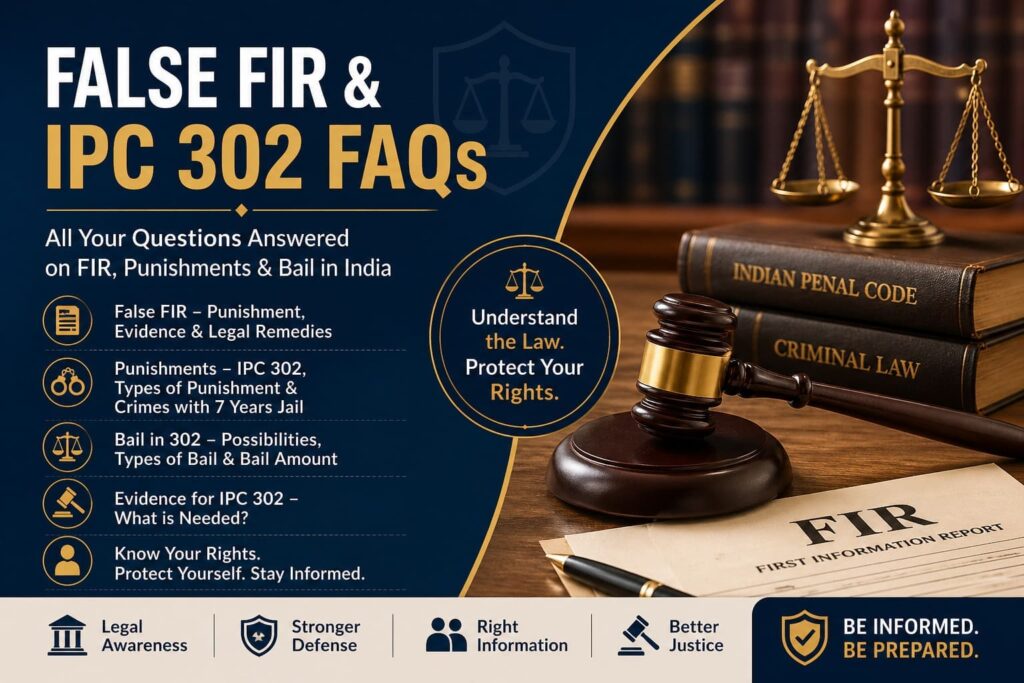
FAQs
Filing a false FIR is a criminal offence in India because it misuses the police and court system and harms an innocent person.
Under the Indian Penal Code, sections like 182 (false information to a public servant) and 211 (false charge of an offence) can lead to imprisonment up to 6 months or 2 years, and in serious cases even up to 7 years, plus fines.
To prove an FIR is false, you must show that the allegations are untrue and were made with bad intention, using strong evidence.
This usually includes documents, CCTV footage, call records, chats, location data, independent witnesses, and contradictions in the complainant’s statements during investigation or trial. Once you gather material, your lawyer can move for anticipatory bail, seek quashing of the FIR in the High Court, or prove falsity during trial through cross-examination and defence evidence.
If a fake FIR is filed against you, do not panic or confront the complainant; instead, contact a criminal lawyer immediately and understand the exact sections mentioned in the FIR.
Your first legal step is usually to apply for anticipatory or regular bail so that you are protected from arrest while you prepare your defence. Next, collect all evidence that shows the case is fabricated and, with your lawyer, consider filing for quashing in the High Court or defending the case at trial and later taking action against the complainant for falsely accusing you.
Knowingly making a false criminal accusation against someone is punishable under IPC sections like 182 and 211, and related provisions in the new Bharatiya Nyaya Sanhita (BNS).
Depending on how serious the false allegation is, the court can impose imprisonment up to 2 years, or up to 7 years when the false accusation relates to a grave offence punishable with 7 years, life imprisonment, or death, along with fines.
Yes, you can report someone who has knowingly made a false accusation or filed a false FIR against you.
In practice, you generally first defend yourself (bail, quashing, or acquittal) and then, with your lawyer’s help, file a complaint before the Magistrate under sections like 182 and 211 IPC (or their BNS equivalents). You may also file a civil suit or criminal complaint for defamation and claim compensation.
Section 302 of the Indian Penal Code provides the punishment for murder.
If a person is convicted under IPC 302, the court can award either the death penalty or imprisonment for life, and may also impose a fine; there is no smaller jail term than life for a valid conviction under this section.
Indian criminal law recognises several kinds of punishments under Section 53 of the IPC.
In simple terms, four main types are: death penalty, imprisonment for life, imprisonment (rigorous with hard labour or simple), and fine as a monetary penalty. The Code also mentions forfeiture of property and, in limited cases, solitary confinement.
Many serious but not “most extreme” offences can carry a maximum punishment of around 7 years’ imprisonment in India.
Examples include certain types of cheating, criminal breach of trust, some types of hurt, and in the context of false cases, filing a false charge that relates to an offence punishable with 7 years or more can itself attract punishment up to 7 years under IPC 211.
Bail in a murder case under IPC 302 is legally possible but difficult, because it is a non-bailable and very serious offence.
Courts consider factors like the strength of the evidence, seriousness of the allegations, risk of absconding, and possibility of tampering with witnesses. If the court is satisfied, it can grant bail on strict conditions; otherwise bail is often refused.
In Indian practice, people commonly talk about four main types of bail.
These are regular bail (after arrest), anticipatory bail (before arrest in a non-bailable offence), interim bail (short-term bail till the main bail application is decided), and default or statutory bail, which arises if police fail to file a chargesheet within the prescribed 60 or 90 days.
For a conviction under IPC 302, the prosecution must prove beyond reasonable doubt that the accused caused the death with the intention or knowledge required for murder under Section 300 IPC.
Courts look at evidence like eyewitness testimony, medical and post-mortem reports, weapon recovery, forensic and DNA evidence, motive, conduct before and after the incident, and consistent investigation records.
There is no fixed “highest bail amount” in Indian law; courts decide bail bonds and surety amounts case-by-case.
For serious economic offences or high-profile cases, courts can impose very large surety or bond amounts, but they must still keep bail conditions reasonable and not so harsh that they effectively deny bail to someone who has been granted it.
Conclusion
The law does give you tools to punish someone who filed a false FIR against you. Sections 217 and 248 of the BNS are real provisions with real consequences. Compensation under Section 273 BNSS is available. Criminal defamation under BNS 356 is an option when your reputation has been publicly damaged.
But none of these remedies are automatic, fast, or guaranteed. They require evidence, patience, a good lawyer, and a realistic understanding of what you are taking on.
If you are facing a false FIR right now, protect yourself first. Get bail, get legal counsel, and start preserving your evidence. Once you are safe, you can make a clear-headed decision about whether and how to pursue the person responsible.
This article is for general informational purposes only and does not constitute legal advice. Laws and their interpretation can vary based on specific facts and jurisdiction. Please consult a qualified criminal lawyer for advice on your specific situation.