
If you are reading this, something has probably already happened. Maybe a police officer stopped you on the road and asked to check your phone. Maybe you were called to the police station and told to unlock it. Or maybe your phone has already been taken, and now you are sitting there confused, asking yourself one question: can the police check your phone?
Take a moment and stay calm. Your concern is valid. Your phone contains your personal life, including bank details, private chats, photos, and work data. Indian law understands how important this is and treats it as part of your right to privacy. There are clear legal rules about when the police can check your phone and when they cannot.
In this article, you will understand these rules in simple language with real life situations, so you know exactly what to do if this happens to you.
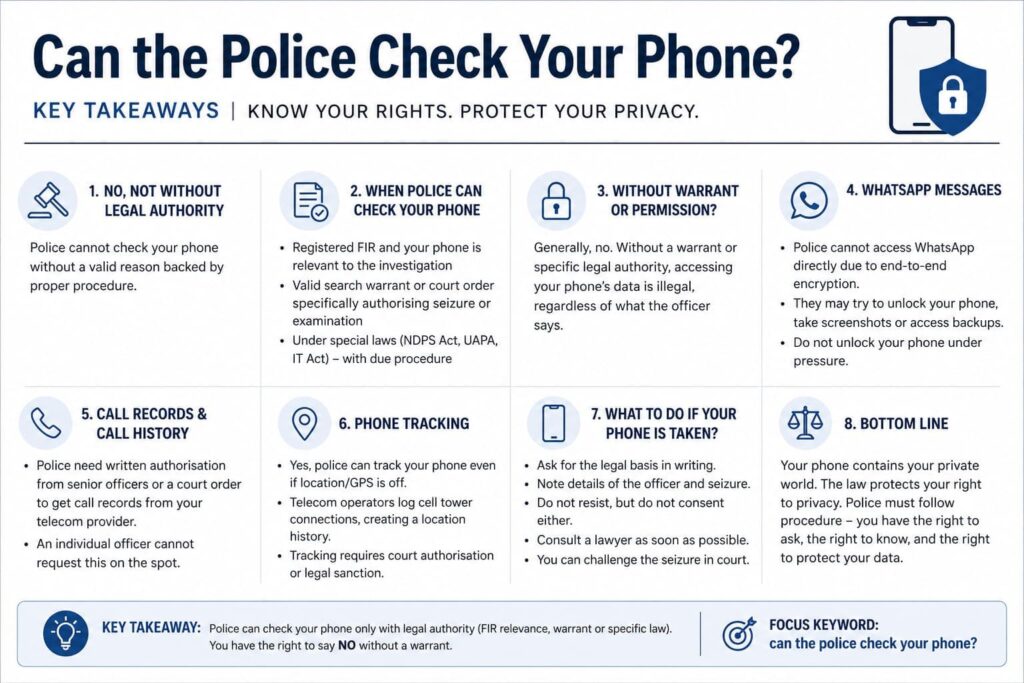
The Basic Rule: When Can Police Check Your Phone in India?
The starting point is the Supreme Court’s landmark judgment in Justice K.S. Puttaswamy vs Union of India (2017), which recognised privacy as a fundamental right under Article 21 of the Constitution. Your phone, with all the data it carries, falls squarely within that protection.
This does not mean the police can never touch your phone. It means they must have a legal reason to do so, and that reason must be backed by proper procedure.
Here is when police can legally check your phone:
- There is a registered FIR and your phone is relevant to the investigation of a specific offence.
- They have a valid search warrant or court order that specifically authorises seizure or examination of your phone.
- In certain serious cases under special laws like the NDPS Act, UAPA, or the IT Act, where slightly different rules may apply, but even then, there are procedures they must follow.
What they cannot do is walk up to you out of curiosity, because you “look suspicious,” or because they simply want to, and start scrolling through your messages and photos. That is not how the law works.
Can Police Check Your Phone Without a Warrant or Your Permission?
This is the question most people want answered directly, so here it is: generally, no. Can police check your phone without a warrant? Not unless there are very specific circumstances that legally justify it, and even then, they must follow procedure.
Now, what about “permission”? A lot of people hand over their phones because an officer says something like, “Don’t worry, just show me, nothing will happen.” That kind of pressure is not free consent. True consent means you voluntarily agreed without any coercion, threat, or false promise. Courts in India have consistently held that statements or actions made under police pressure carry very little legal weight.
Can police check my phone without permission? In law, the answer is tied to whether there is a valid warrant or specific legal authority. Without either, accessing your phone’s data is illegal, regardless of what the officer tells you on the spot.
Here are two situations people face all the time:
Situation 1: You are stopped at a late-night nakabandi and an officer says, “We need to check your phone for suspicious messages.” There is no FIR, no warrant, no specific case. This is a general exploratory check, and you have every right to politely ask under which law or case they are doing this.
Situation 2: You are called to a cyber cell as a witness in a fraud case involving a friend. The officer says, “Just unlock your phone for ten minutes, we only want to see one thing.” Even as a witness, you are not obligated to hand over your phone without a written order or warrant.
In both situations, staying calm and asking for the legal basis in writing is the right move. Do not shout, do not refuse aggressively, but do ask the question clearly.
Can Police Check Your Phone Records and Call History?
There is an important difference here that most people are not aware of.
Your phone itself, the device in your hand, contains your WhatsApp messages, photos, emails, and installed apps. Your phone records, meaning call detail records or CDRs, are stored with your telecom operator, not on your physical device.
Can police check your phone records with your telecom provider? They can, but only with proper written authorisation, typically from a senior officer at the level of a Superintendent of Police or above, or through a court order. An individual officer on the street cannot simply call your telecom provider and request your call history without going through this process.
Informal access, meaning an officer quietly calling the telecom provider without following the proper authorisation chain, is an abuse of power. If you suspect this has happened, a lawyer can help you raise the issue formally.
Can Police Check Your WhatsApp Messages?
This one worries people a lot, and rightly so.
Can police check your WhatsApp messages? The honest answer depends on how they are trying to access them.
If they physically get into your phone, they can see your WhatsApp chats exactly as you see them. End-to-end encryption protects messages while they are in transit between users, but once they are sitting on your unlocked device, that protection is irrelevant.
If they approach WhatsApp directly, the situation is different. WhatsApp’s encryption means they cannot hand over the content of your messages. However, metadata, meaning who you spoke to, when, for how long, can be shared. And if your WhatsApp chats are backed up to Google Drive or iCloud without encryption, those backups may be accessible through legal process.
In practice, most police attempts to access WhatsApp in India involve one of the following:
- Pressuring you to unlock your phone and show them specific chats.
- Asking you or forcing you to take screenshots.
- Trying to access device backups if your phone has been seized.
The practical takeaway: if your phone is in your hands, do not unlock it under pressure. If it has been seized, the police still need permission from the court to conduct a forensic examination of its data in most cases.
Can Police Track Your Phone Even If Your Location Is Off?
Many people think that turning off GPS or disabling location services makes them untraceable. This is not entirely true.
Can police track your phone if location is off? Yes, to a degree, even without GPS being active. Telecom operators continuously log which cell towers your phone connects to. This creates a historical record of your approximate location. With proper legal authorisation from senior officers or a court, law enforcement can obtain this data from your telecom provider.
App-based real-time location sharing and GPS-based tracking, however, do require court authorisation or specific legal sanction. It is not something a local police station can do casually.
The important point is that phone tracking of any kind is tightly regulated because it is a serious invasion of privacy. It cannot be done simply because an officer decides to.
Can Border Police or Airport Security Check Your Phone?
This is a situation that catches many travellers off guard.
There is a clear difference between routine airport security and a deep search of your phone. Metal detectors, baggage scans, and checking a boarding pass on your phone screen are all normal security processes. Demanding access to your personal chats, browsing your photos, or going through your emails is a completely different matter.
Can border police check your phone in this deeper sense? Not without specific legal grounds and procedure. Even at international borders or airports, any meaningful examination of the contents of your phone requires legal justification, not just a general security concern.
If this happens to you at an airport, stay calm, ask politely what law or specific reason justifies the check, and if your phone is taken without any documentation, call a lawyer as soon as possible.
What If the Police Have Already Taken Your Phone?
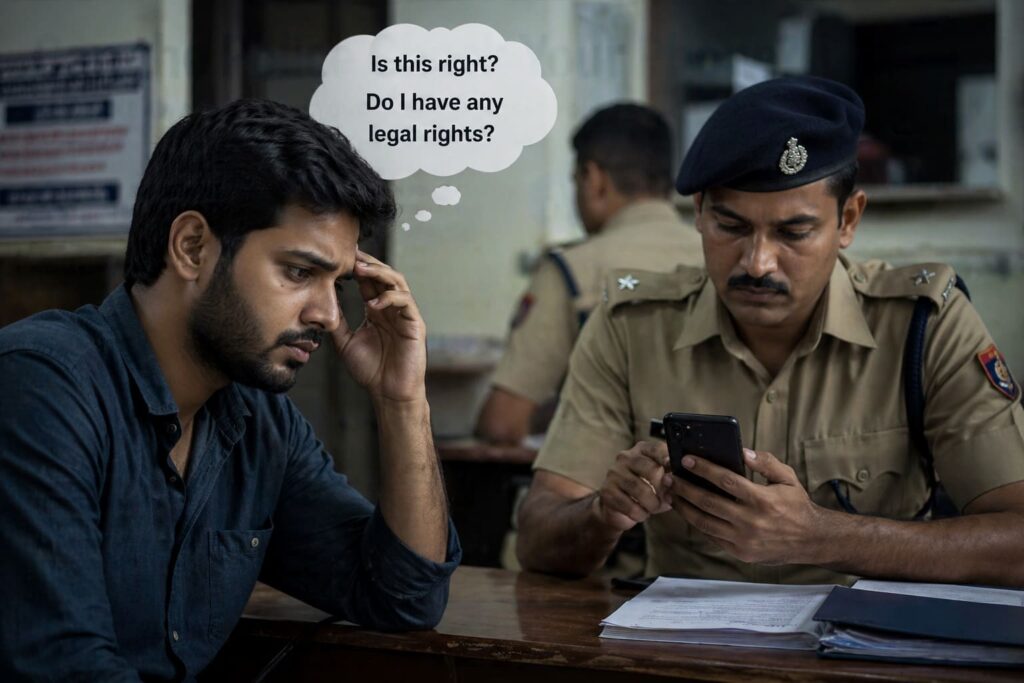
If your phone has already been seized, the first thing to understand is that seizing your phone is not the same as having legal permission to go through everything on it. In many cases, police still need a court’s permission before conducting a full forensic examination of your data.
Under the Bharatiya Nagarik Suraksha Sanhita (BNSS), which governs criminal procedure in India today, any search and seizure should be documented with a seizure memo, ideally with a witness (panchnama), and in many cases with video recording of the process. If this was not done when they took your phone, that is a procedural lapse you should document.
If police took my phone without a warrant, here is what you need to do:
- Ask for and keep a copy of any seizure memo or receipt they gave you.
- Note the name, badge number, and police station of the officer involved.
- Note whether any FIR has been filed and, if so, its number.
- If no case is registered, ask in writing why the phone was taken.
As for how to get your phone back: this is where speaking to a lawyer quickly makes a real difference. A lawyer can file an application before the concerned court seeking return of property. If the seizure was done without following proper procedure, the lawyer can challenge it. Waiting, hoping it resolves on its own, is usually the worst approach because it gives time for data to be accessed and for your position to weaken.
It is also worth reading up on your rights during arrest more broadly, since police interactions do not always stay limited to phones. Knowing what your rights are during an arrest can help you handle the entire situation more confidently. And if the police are refusing to file an FIR in a related matter, you should know what steps you can take when police refuse to file an FIR.
What Should You Do Right Now?
Whether the police are currently asking for your phone or have already taken it, here is what you should do:
If police are asking to see your phone right now:
- Stay calm. Do not shout, argue loudly, or make aggressive statements.
- Ask politely: “Sir/Madam, may I know under which case or law you are asking to check my phone?”
- Ask if they have a warrant or any written order.
- If you are not comfortable handing it over, say so clearly but without aggression.
- Do not delete anything in panic. Deleting messages or photos on the spot can be misread as destruction of evidence, which creates a much bigger problem.
- Note the names, badge numbers, and any witnesses present.
If your phone has already been taken:
- Collect all documents they gave you at the time of seizure.
- Do not use a borrowed phone to contact other people involved in the matter in ways that could complicate your case.
- Contact a criminal lawyer or cyber law lawyer quickly. The earlier you get advice, the more options you have.
FAQs People Ask Indian Lawyers About Police Checking Their Phones
Frequently Asked Questions about Police Checking Your Phone
No. Routine checking does not give police the right to scroll through your phone. They need a specific legal basis, either a case under investigation or a valid warrant.
Even with an FIR, they must follow procedure. They generally still need a warrant or court authorisation to examine the contents of your phone. Simply being named in an FIR does not give them unlimited access to your device.
They can request call detail records from your telecom operator, but only with written authorisation from a senior officer or a court order. An individual officer cannot legally do this informally.
If they have your unlocked phone, they can see what is visible on the device. Deleted chats may or may not be recoverable, depending on backups and technical tools. Content is encrypted while it travels over the internet, but on-device data is not protected once the phone is unlocked and in their hands.
They cannot conduct a deep search of your personal data without specific legal grounds. Routine security checks, like scanning bags or quickly checking a boarding pass on your phone, do not give them the right to go through your private messages and photos.
Cell tower data from your telecom provider can still be used to place your phone in a general area, even if GPS or app location is off. This kind of tracking requires proper legal authorisation but does not depend on your phone’s location setting being turned on.
In many everyday situations, no, it is not legal. You should ask for documentation of the seizure, note the officer’s details and the place and time, and speak to a lawyer immediately. You may be able to challenge the seizure and apply to get your phone returned through the court.
You can refuse to unlock your phone without a warrant or written order. Do this politely and calmly. Do not create a confrontation. Ask for the legal basis in writing and keep a record of everything that happens.
You can say clearly but calmly that you want to cooperate, but you would like to know the legal basis for the check. Ask the officer to provide a written order or tell you which case this relates to. This is a reasonable and lawful request.
Talk to a Lawyer Before the Situation Gets Harder to Fix
The law gives you rights. But those rights only protect you if you know them and act on them at the right time.
If you hand over your phone without question, say something in a statement that you later regret, or wait too long to challenge an illegal seizure, you make your own situation worse. These are exactly the mistakes an early conversation with a lawyer helps you avoid.
A lawyer can check whether the seizure was legal, help you file for the return of your phone, limit how much of your data can be accessed, and represent you if the situation escalates. This kind of early advice protects both you and your data far more effectively than waiting to see what happens.
If you have been reading this because something is already happening to you right now, do not wait. Reach out for a confidential consultation. Share the basic details: when and where your phone was taken or asked for, which police station is involved, and whether any FIR or notice has been issued. The sooner you get proper advice, the more options you will have.
Pingback: Can Police Track a Deleted Instagram Account in India