
A dispute over a grandfather’s house. A brother blocking a sister from claiming her share. A son surprised to learn he had rights even before he was born. These are not rare stories, they play out every day in Indian courts and family homes.
If you have ever wondered what is ancestral property, whether you have a claim to it, or how it is divided among family members, you are in the right place. This guide breaks it all down; clearly, practically, and without unnecessary legal jargon.
By the end of this article, you will understand:
- The exact legal meaning of ancestral property in India
- How it differs from inherited property
- Who can claim it and when
- How the Supreme Court has interpreted the law
- What you should do if you believe your rights are being denied
What Is Ancestral Property? The Legal Definition
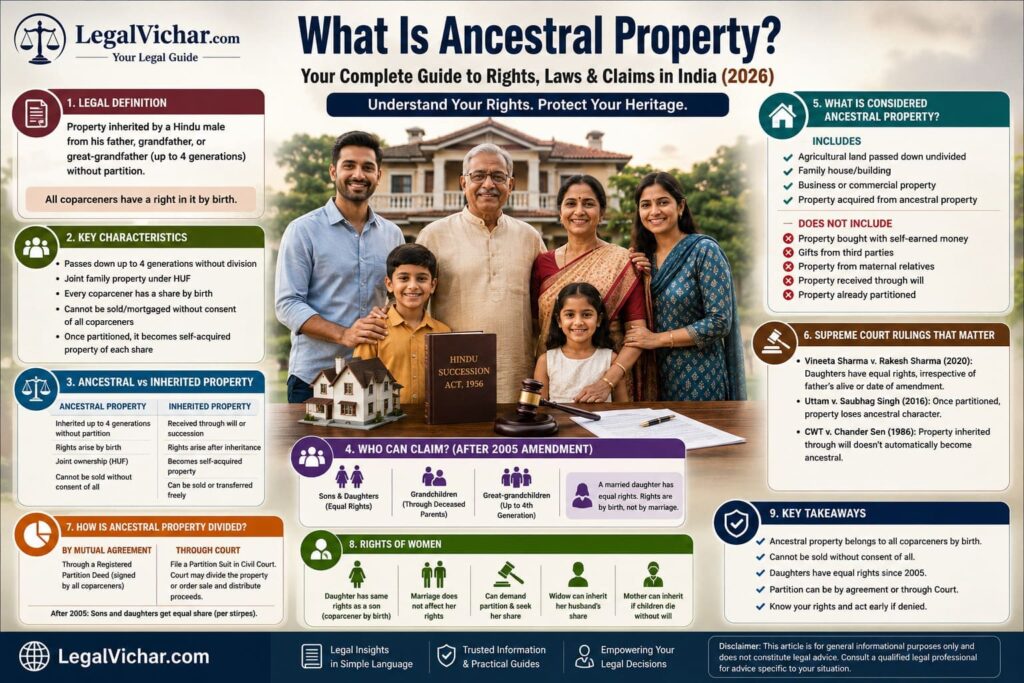
In simple terms, ancestral property is property that a Hindu male inherits from his father, grandfather, or great-grandfather; that is, up to three generations above him. The key condition is that this property must not have been divided or partitioned in the family before it reaches the current generation.
Under the Hindu Succession Act and the rules of the Hindu Undivided Family (HUF), ancestral property belongs jointly to all male members of the family from birth. After the 2005 amendment, daughters too have equal coparcenary rights — more on this shortly.

Key Characteristics of Ancestral Property
- It passes down through four generations; from great-grandfather to great-grandson without division.
- It is held as joint family property under the HUF framework.
- Every coparcener (family member with a birth right) has a share in it.
- No single person can sell or mortgage it without the consent of all coparceners.
- Once partitioned formally, it becomes self-acquired property of each person’s share.
Important: This framework primarily applies to Hindus, Buddhists, Jains, and Sikhs. Muslims, Christians, and Parsis follow different personal laws regarding inheritance.
What Is Ancestral Property Under Hindu Law vs Inherited Property?
This is where most people get confused and understandably so. The two terms sound similar but carry very different legal meanings.
Ancestral Property
Ancestral property is property that has been in the family for at least four generations without formal division. Rights to it arise by birth, meaning a child has a legal claim to it from the moment they are born into the family, or even from the moment of conception.
Example: Your great-grandfather bought agricultural land. It passed to your grandfather, then to your father, but was never legally partitioned. That land is ancestral property. You have a share in it from birth.
Inherited Property
Inherited property is property that someone receives through a will or through intestate succession (when there is no will). Once you inherit it, it becomes your self-acquired property. You can sell it, will it to anyone, or mortgage it without needing anyone else’s consent.
Example: Your father bought a flat with his own earnings and left it to you in a will. That flat is inherited property — it belongs to you alone, not to the entire family.
The core difference: Ancestral property involves joint ownership and birth rights. Inherited (self-acquired) property passed through a will becomes the sole property of the receiver. If you are dealing with a property dispute, this distinction can be decisive. Consider speaking with a property law specialist.
What Is Considered Ancestral Property in India? Common Examples
Not every property that belonged to your ancestors qualifies as ancestral property under Indian law. Here is what typically counts and what does not.
Typically Qualifies as Ancestral Property
- Agricultural land inherited through up to four generations without partition
- A family home or building that has been passed down undivided
- Business assets or commercial property that form part of HUF property
- Property acquired using the income or funds from ancestral property
Does NOT Qualify as Ancestral Property
- Property your father bought with his own money (self-acquired property)
- A gift your grandfather received from a third party (it becomes his self-acquired property)
- Property inherited from maternal relatives (mother’s side)
- Property received through a will (it becomes self-acquired for the recipient)
- Property that has already been formally partitioned among family members
Who Can Claim Ancestral Property in India?
This is one of the most asked questions, and the answer changed significantly in 2005.
Before the 2005 Amendment
Only male members of the Hindu family had coparcenary rights, meaning only they could claim a share in ancestral property by birth. Daughters were excluded unless they were unmarried and living in the family home.
After the Hindu Succession (Amendment) Act, 2005
The 2005 amendment was landmark. Under Section 6, daughters were granted equal coparcenary rights in ancestral property — the same as sons. This means:
- Daughters have a right to a share in ancestral property from birth
- Marriage does not affect this right — a married daughter retains her claim
- If a daughter has passed away, her children can claim her share
So who can claim ancestral property in India today?
- Sons and daughters (equal rights)
- Grandchildren (through deceased parents)
- Great-grandchildren (up to the fourth generation)
Note: A wife does not have a coparcenary right in her husband’s ancestral property by birth. However, she has rights of maintenance and may inherit a share upon his death under succession laws.
What Is Ancestral Property — Supreme Court Rulings That Matter
Courts have shaped how ancestral property laws work in practice. Here are the most important judicial positions that affect your rights today.
Vineeta Sharma v. Rakesh Sharma (2020)
This Supreme Court ruling clarified that daughters have coparcenary rights in ancestral property regardless of whether their father was alive on or before the 2005 amendment date. Even if the father had died before 2005, the daughter still has a rightful share. This was a watershed ruling for daughters across India.
Uttam v. Saubhag Singh (2016)
The Supreme Court held that once a joint family property is partitioned — even informally — it loses its character as ancestral or joint property. Each person’s share becomes their individual property. This ruling is frequently used to challenge claims when property has changed hands over decades.
Commissioner of Wealth Tax v. Chander Sen (1986)
The Court ruled that when property inherited by a Hindu under a will is put into a joint family pool, it does not automatically become ancestral property. The nature of how property enters the HUF matters deeply.
How Is Ancestral Property Divided in India?
The division of ancestral property follows specific rules under Indian law. Here is a straightforward breakdown.
By Mutual Agreement (Partition Deed)
Family members can mutually agree to partition the property. This is done through a Partition Deed — a legal document that outlines each person’s share. It should be signed by all coparceners, witnessed, and registered with the local Sub-Registrar.
Key point: Stamp duty applies on partition deeds, and registration is mandatory for it to be legally valid in most Indian states.
Through a Civil Court (Partition Suit)
If the family cannot agree, any coparcener can file a Partition Suit in civil court. The court will:
- Determine all coparceners and their respective shares
- Attempt physical division of the property (metes and bounds)
- If physical division is not possible (e.g., a single apartment), order the sale of the property and distribute proceeds
Equal Share Rule
After the 2005 amendment, sons and daughters receive equal shares in ancestral property. The division is done per stirpes; meaning if a person has died, their share goes to their children.
Example: A father dies with three children — two sons and a daughter. All three receive equal one-third shares in the ancestral property.
Rights of Women in Ancestral Property Under Indian Law
Women’s rights in ancestral property have evolved significantly. Here is what every woman — and her family — should know.
- A daughter has the same rights as a son — she is a coparcener by birth.
- Marriage does not affect her rights. A married daughter retains her share.
- A daughter can demand partition and seek her share through court if denied.
- A widow does not have coparcenary rights but can claim her deceased husband’s share through succession.
- A mother can inherit property on the death of her children if they die without a will or coparceners.
For a detailed look at women’s property and financial rights in India, including during divorce, see our guide on Rights of Woman in Divorce (2026 Guide): Maintenance, Property & Custody Explained.
Frequently Asked Questions About Ancestral Property in India
1. Can a father sell ancestral property without the consent of his children?
No. Ancestral property cannot be sold by any single coparcener including a father, without the consent of all other coparceners. If a father sells ancestral property without consent, the children can challenge the sale in court. The burden of proof lies on the purchaser to show that the sale was for a legal necessity or with family consent.
2. Is property received through a will considered ancestral property?
No. Property received through a will becomes the self-acquired property of the person who inherits it. It does not automatically become ancestral property. However, if the person chooses to blend it into the HUF pool and treats it as joint family property, courts may recognize it differently, but this requires clear intent and action.
3. Can an adopted child claim ancestral property?
Yes. Under the Hindu Adoption and Maintenance Act, 1956, a legally adopted child has the same rights as a biological child. This includes coparcenary rights in ancestral property. However, informal or unregistered adoptions may face legal scrutiny, so it is important to ensure the adoption is formal and documented.
4. How many generations does ancestral property cover?
Ancestral property covers four generations, from the original owner (great-grandfather) through grandfather, father, and son. Beyond four generations, property no longer retains its ancestral character. Each new link in the chain must be an unbroken line of inheritance without formal partition.
5. What happens if ancestral property has been sold fraudulently?
If ancestral property has been sold without the consent of all coparceners or through fraud, the affected parties can file a civil suit to challenge and cancel the transaction. They may also seek an injunction to prevent further transfer. Courts have consistently upheld the rights of coparceners in such cases, particularly when there is evidence of misrepresentation or lack of legal necessity.
Related Legal Guides You May Find Useful
- What Is a Contested Divorce in India? Process, Evidence, Cost and Practical Reality
- How to Protect Assets From Divorce India: Legal and Practical Steps Before Things Get Messy
- Mental Harassment Complaint to Police: Legal Rights of Wife Against Emotional Abuse by Husband
- Rights of Woman in Divorce (2026 Guide): Maintenance, Property & Custody Explained
- Marriage Registration in Gurgaon: Complete Procedure, Hidden Documents & Fees (2026 Guide)
- Is Live-In Relationship Legal in India? Rights, Laws & What You Should Do (2026 Guide)
Final Thoughts: Protecting Your Rights in Ancestral Property
Ancestral property law in India is nuanced, and disputes around it can be emotionally charged and legally complex. Whether you are a son, daughter, grandchild, or widow — the law has provisions to protect your rightful share. But knowing the law is only the first step.
Here is what you should take away from this guide:
- Ancestral property belongs to all coparceners by birth — sons and daughters equally since 2005.
- It cannot be sold without the consent of all family members with a stake in it.
- The Supreme Court has consistently upheld these rights — including for daughters whose fathers died before 2005.
- Division can happen amicably through a partition deed, or through a civil court if the family disputes it.
If you suspect your rights to ancestral property are being ignored, delayed, or actively denied, do not wait. Property disputes often become harder — and more expensive — to resolve the longer they drag on. Speaking to a qualified property lawyer early gives you the clearest picture of what you are entitled to and how to claim it.
Have a specific situation you need clarity on? Consider consulting a family lawyer or property lawyer who can review the facts of your case and guide you through the legal options available to you.
Pingback: Difference Between Ancestral Property and Inherited Property: What Indian Family Should Know