
Running a business in India often starts informally. One family member handles accounts, another deals with suppliers, someone else manages GST filings, and the legal owner — at least on paper — may not even be involved in day-to-day operations. Things continue smoothly until one day a police notice arrives, a complaint gets filed, or authorities begin asking questions about transactions the proprietor claims they never approved.
That is where the problem begins.
A lot of business owners assume that if they personally did not commit the wrongful act, they cannot be held responsible. In practice, Indian criminal law does not always work that way. When a proprietorship, partnership, or company becomes involved in alleged fraud, cheating, illegal sale of goods, tax irregularities, cyber offences, or financial misconduct, investigating agencies usually start with the person whose name appears officially connected to the business.
This is exactly why understanding corporate criminal liabilities in India has become important not only for company directors and large corporations but also for small business owners, proprietors, startup founders, and even family-run firms.
In many cases, the biggest mistake is not the offence itself. It is the assumption that “I was only the namesake owner” will automatically protect someone from liability.
Indian courts often examine:
- who benefited from the transaction,
- who exercised control,
- who signed documents,
- whether negligence existed,
- whether illegal activities were knowingly ignored,
- and whether the business structure was used to shield responsibility.
For ordinary business owners, this becomes a serious legal and financial risk.
What Are Corporate Criminal Liabilities in India?
Corporate criminal liabilities in India refer to situations where a company, business entity, proprietor, director, partner, or responsible individual may face criminal prosecution for unlawful acts connected to business operations.
Earlier, criminal law mainly focused on individuals. Over time, Indian courts recognised that companies and business entities can also become vehicles for fraud, cheating, money laundering, cyber offences, environmental violations, financial manipulation, and regulatory breaches.
Today, criminal liability may arise in cases involving:
- cheating and fraud,
- fake invoicing,
- GST fraud,
- cyber offences,
- data theft,
- criminal breach of trust,
- illegal sale of goods,
- financial misrepresentation,
- white collar crimes,
- employee misconduct,
- digital payment fraud,
- misleading advertisements,
- regulatory non-compliance.
Even though a company itself is not a physical person, the law can still prosecute:
- directors,
- managers,
- authorised signatories,
- compliance officers,
- proprietors,
- and individuals responsible for decision-making.
In India, courts often apply the concept of “vicarious liability” in specific circumstances. This means a person may become legally responsible for actions committed by another person connected to the business, especially where negligence, consent, knowledge, or control can be shown.
Why Proprietorship Businesses Face Higher Risk
In a proprietorship business, there is no separate legal identity between the owner and the business.
This changes everything.
Unlike a private limited company where liability may sometimes be separated from personal ownership, a proprietorship directly connects the individual with the business operations.
Suppose:
- the GST registration is in your name,
- invoices are issued under your proprietorship,
- bank accounts are linked to your PAN,
- employees work under your business identity,
then authorities will usually treat you as the responsible person first.
Even if:
- your brother handled operations,
- your father controlled inventory,
- your spouse managed finances,
- or an employee conducted illegal transactions,
the proprietor may still come under investigation.
This becomes particularly dangerous in family-run businesses where operational responsibilities are rarely documented properly.
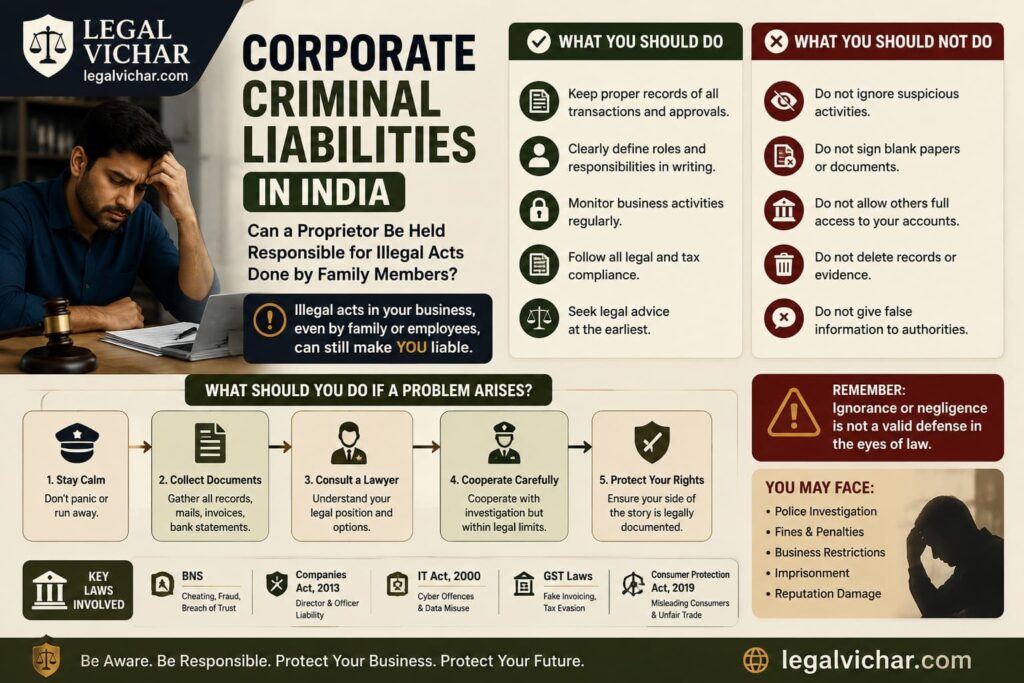
Can a Proprietor Be Held Liable for Illegal Acts Done by Family Members?
Yes, under certain circumstances, a proprietor can face criminal liability for illegal acts carried out by family members operating the business.
However, liability does not arise automatically in every situation.
Investigating agencies and courts generally examine:
- whether the proprietor had knowledge of the activity,
- whether they ignored obvious warning signs,
- whether financial benefit was received,
- whether business accounts were controlled by them,
- whether signatures or authorisations existed,
- whether negligence contributed to the offence.
For example, if a family member illegally sells restricted goods using the proprietor’s business licence, authorities may investigate:
- who authorised the transaction,
- whose bank account received payment,
- whose GST number was used,
- whether fake invoices were generated,
- whether inventory records were manipulated.
Simply saying “I was unaware” may not be sufficient if documents show active involvement or negligence.
At the same time, Indian law also recognises that some proprietors genuinely become victims of misuse by relatives, employees, or business associates. Proper documentation, communication records, compliance history, and legal representation become extremely important in such situations.
Difference Between Civil Liability and Criminal Liability
Many business owners confuse civil disputes with criminal offences.
The difference matters because criminal proceedings can involve:
- police investigation,
- arrest,
- seizure of records,
- custodial interrogation,
- criminal prosecution,
- and imprisonment.
Civil liability usually involves:
- compensation,
- financial recovery,
- contractual disputes,
- damages,
- or business disagreements.
Criminal liability, on the other hand, involves offences against the State.
For instance:
- breach of contract may be civil,
- but deliberate cheating or forged invoices may become criminal.
Similarly:
- delayed payment may remain civil,
- but fraudulent inducement or dishonest intention can attract criminal charges.
This distinction is important because many commercial disputes in India now increasingly involve criminal complaints alongside civil proceedings.
Corporate Criminal Liability Under Indian Laws
Several Indian laws may create criminal liability for businesses and responsible individuals.
Bharatiya Nyaya Sanhita (BNS)
The Bharatiya Nyaya Sanhita, which replaced many provisions of the Indian Penal Code, contains offences relating to:
- cheating,
- forgery,
- criminal breach of trust,
- fraud,
- conspiracy,
- misappropriation.
If a business operation involves dishonest conduct, authorities may invoke these provisions against individuals connected to the business.
Companies Act, 2013
The Companies Act, 2013 imposes liability for:
- fraudulent conduct,
- false statements,
- non-disclosure,
- financial manipulation,
- failure in compliance obligations.
Directors and key managerial personnel may face prosecution where active involvement or negligence is established.
Information Technology Act, 2000
Digital businesses and online platforms may face criminal exposure under the IT Act in matters involving:
- data theft,
- hacking,
- unauthorised access,
- identity fraud,
- cyber cheating,
- misuse of customer information.
This is becoming increasingly relevant for startups, e-commerce sellers, and businesses handling online payments.
GST and Financial Compliance Laws
Fake invoicing, wrongful input tax credit claims, shell transactions, and fraudulent billing can trigger:
- GST investigations,
- economic offences proceedings,
- attachment of bank accounts,
- and criminal prosecution.
In many GST fraud investigations, authorities first identify the registered proprietor or authorised signatory.
Can Company Directors Be Prosecuted?
Yes, company directors can be prosecuted in India, but liability generally depends on their role and involvement.
Courts usually examine:
- whether the director was in charge of operations,
- whether there was active participation,
- whether negligence occurred,
- whether statutory duties were ignored.
A director cannot always escape liability simply by claiming they were non-executive or inactive, especially where evidence shows awareness or approval of wrongful conduct.
However, courts also avoid mechanically prosecuting every director without evidence. Indian judiciary has repeatedly emphasised that criminal liability should not be imposed casually.
This becomes important in family businesses where multiple relatives are designated as directors but operational control rests with only one or two individuals.

What Happens When Employees Commit Illegal Acts?
Employee misconduct can also expose businesses to criminal investigations.
Common examples include:
- fake billing,
- unauthorised discounts,
- inventory theft,
- cyber fraud,
- misuse of customer databases,
- digital payment manipulation,
- forged documents.
Authorities often investigate whether:
- internal supervision existed,
- compliance systems were followed,
- management ignored red flags,
- complaints were previously raised,
- or financial benefits reached senior management.
A business with no compliance mechanism appears more vulnerable during investigations.
This is why even small businesses should maintain:
- written authorisations,
- access control,
- digital records,
- employee communication trails,
- accounting supervision.
Real-Life Practical Scenario
Suppose a proprietorship trading firm is registered in the name of one person, but daily operations are handled by family members.
One relative begins selling duplicate electronic products using genuine GST invoices. Customers later complain of fraud. Authorities discover:
- fake inventory entries,
- manipulated invoices,
- suspicious bank transfers,
- misleading product descriptions.
Now the registered proprietor may receive:
- police notices,
- GST investigation notices,
- requests for financial records,
- summons for questioning.
Even if the proprietor was not personally selling the products, investigators will still examine:
- whether profits entered their accounts,
- whether they ignored irregularities,
- whether they knowingly allowed misuse of the business.
This is how corporate criminal liabilities in India operate in practice.
What Should a Proprietor Do Immediately in Such Situations?
Panic usually makes situations worse.
Some business owners destroy records, avoid authorities, or rely entirely on verbal explanations. That approach can create additional suspicion.
A better approach usually includes:
Preserve Business Records
Maintain:
- invoices,
- GST filings,
- bank statements,
- email communications,
- employee records,
- accounting entries.
Digital evidence matters heavily in commercial investigations.
Consult a Lawyer Early
Waiting until arrest risk increases is often a mistake.
An advocate can help:
- review exposure,
- prepare responses,
- identify procedural safeguards,
- and protect against unnecessary admissions.
Avoid False Statements
Contradictory explanations frequently damage credibility during investigations.
Conduct Internal Review
Check:
- financial records,
- user access,
- payment trails,
- compliance failures,
- employee involvement.
Cooperate Carefully
Cooperation does not mean making uncontrolled statements without legal guidance.
Related legal concepts readers explore next
These legal guides help readers understand matrimonial asset protection and constitutional principles connected with Article 14 and reasonable classification.
How to Protect Assets From Divorce in India
Learn practical legal safeguards, ownership structures, financial documentation strategies, and precautions that may help protect assets during matrimonial disputes.
Doctrine of Reasonable Classification under Article 14
Understand how Indian courts examine whether State classification is legally valid and how Article 14 protects against arbitrary discrimination.
Role of Digital Evidence in Business Liability Cases
Modern commercial investigations heavily depend on digital evidence.
Authorities increasingly examine:
- WhatsApp chats,
- emails,
- accounting software,
- cloud records,
- online transaction history,
- UPI trails,
- GST portal activity,
- e-commerce dashboards.
Even deleted communications may sometimes become recoverable during forensic analysis.
Businesses involved in online commerce should especially maintain:
- proper terms and conditions,
- refund policies,
- privacy compliance,
- invoice transparency,
- secure payment systems.
Weak digital compliance often increases suspicion during investigations.
Consumer Protection Angle
Corporate misconduct does not only affect regulators. Consumers are increasingly filing complaints regarding:
- fake products,
- misleading advertisements,
- refund denial,
- digital scams,
- hidden charges,
- online service fraud.
Under consumer protection laws, businesses may face:
- compensation claims,
- penalties,
- reputational harm,
- platform restrictions,
- regulatory scrutiny.
This becomes particularly serious when online reviews, social media complaints, or viral allegations damage public trust.
Can a Criminal Case Be Filed Against a Company?
Yes, criminal cases can be filed against companies in India.
Indian courts recognise that corporations may face prosecution for offences committed through individuals acting on behalf of the organisation.
Depending on the facts, proceedings may involve:
- the company itself,
- directors,
- managers,
- authorised officers,
- proprietors,
- compliance heads.
Punishment may include:
- fines,
- attachment of property,
- regulatory restrictions,
- imprisonment of responsible individuals.
What Is a Corporate Criminal Offence?
A corporate criminal offence refers to unlawful conduct committed in connection with business activities.
Examples may include:
- accounting fraud,
- corruption,
- cyber fraud,
- financial misrepresentation,
- insider misconduct,
- GST fraud,
- environmental violations,
- consumer deception.
In many cases, the offence is not committed by one person alone. Instead, it results from collective business conduct, negligence, or intentional concealment.
How Businesses Can Reduce Criminal Liability Risks
Even small businesses should build basic compliance systems.
Some practical measures include:
- Written authorisations for financial transactions
- Proper accounting supervision
- Limited access to GST and banking credentials
- Employee verification procedures
- Cybersecurity safeguards
- Vendor due diligence
- Periodic internal audits
- Documentation of management responsibilities
Family businesses often ignore these practices until disputes or investigations arise.
FAQs
Corporate criminal liability FAQs
A polished accordion block for WordPress Gutenberg with click-to-reveal answers and built-in structured data for FAQ rich results.
Corporate criminal liability refers to situations where a company or individuals connected to business operations may face criminal prosecution for unlawful acts committed during commercial activities.
It depends on the facts. Authorities usually examine knowledge, negligence, supervision, financial benefit, and involvement before determining liability.
Yes. Indian law permits criminal prosecution of companies as well as responsible individuals connected with the offence.
Civil liability mainly involves compensation and disputes between parties, while criminal liability involves offences punishable by the State through prosecution, fines, or imprisonment.
Yes, especially where active involvement, consent, negligence, or failure in statutory duties is established.
Common examples include fraud, fake invoicing, cybercrime, GST fraud, financial manipulation, corruption, and misleading consumers.
Conclusion
Corporate criminal liabilities in India are no longer limited to large corporations or high-profile financial scams. Small businesses, proprietorship firms, startups, online sellers, and family-run enterprises increasingly face scrutiny when commercial activities cross legal boundaries.
One of the biggest risks today is informal business management. Many proprietors allow relatives, employees, or associates to operate the business without proper documentation, supervision, or compliance systems. When disputes arise or authorities begin investigating, the registered owner often becomes the first person questioned.
At the same time, liability is not automatic. Indian law still requires examination of intent, knowledge, negligence, benefit, and operational control. Proper records, legal guidance, compliance practices, and transparent conduct can significantly affect how liability is assessed.
For business owners, the safer approach is simple: treat compliance seriously before problems arise, not after notices begin arriving.