
Changing jobs sounds exciting until the notice period conversation begins. Many employees in India accept a new offer only to realise that their current company expects them to serve a 60 or 90 day notice period. The new employer wants immediate joining, HR starts talking about recovery clauses, and suddenly the employee is stuck between two companies.
This is where notice period buyout becomes relevant.
A notice period buyout is not just an HR formality. It directly affects salary, relieving letters, full and final settlement, future employment verification, and sometimes even legal disputes. In many private companies, employees are confused about whether they can legally leave early, whether the employer can deny the request, or whether salary can be withheld during the exit process.
A lot of online articles explain notice period buyout in very generic terms. But in reality, the issue becomes complicated when employment contracts, salary recovery, company policy, labour law principles, and professional reputation all come together.
This guide explains how notice period buyout works in India, how the amount is calculated, whether companies can reject it, and what employees should practically keep in mind before making a decision.

What is Notice Period Buyout?
Notice period buyout means paying compensation to the employer instead of serving the complete notice period mentioned in the employment agreement.
Most private companies in India include a notice clause in the appointment letter. The clause usually states that either party can terminate employment by giving prior notice or salary in lieu of notice.
For example:
- A company may require 90 days notice before resignation.
- The employee may want to leave within 30 days.
- The remaining 60 days can sometimes be compensated financially.
In such situations, the company may allow a notice period buyout after recovering the applicable amount from the employee’s salary or final settlement.
The concept mainly exists to compensate the employer for sudden workforce disruption, project dependency, client handling, or replacement costs.
Why Companies Insist on Notice Period
Many employees assume notice periods are unnecessary corporate pressure tactics. In practice, companies use notice periods for operational continuity.
A sudden employee exit can affect:
- Client deliverables
- Sensitive data access
- Ongoing litigation or compliance work
- Internal handovers
- Financial approvals
- Technical transition
- Team productivity
This becomes even more important in sectors like:
- IT services
- Legal process outsourcing
- Banking and finance
- Healthcare
- Compliance consulting
A notice period gives the employer time to arrange replacements and secure company assets before relieving the employee.
Is Notice Period Buyout Legal in India?
Yes, notice period buyout is generally legal in India if it is part of the employment agreement or company policy.
Indian employment relationships are largely contractual in private sector jobs. Courts usually examine:
- Appointment letter terms
- HR policy documents
- Mutual agreement between employer and employee
- Whether the clause is reasonable
- Whether recovery is excessive or punitive
There is no single central law in India exclusively governing notice period buyout for all private employees. Instead, the issue is interpreted through:
- Indian Contract Act, 1872
- Industrial employment principles
- State Shops and Establishments Acts
- Labour law jurisprudence
- Employment contract terms
In practical situations, most companies rely on contractual clauses rather than litigation because legal recovery proceedings are time consuming and expensive.
However, problems arise when:
- The employee leaves without approval
- The company withholds relieving documents
- Recovery amount becomes unreasonable
- Salary deductions exceed legal limits
- There is coercive HR conduct
That is where legal interpretation becomes important.
Can a Company Legally Reject Notice Period Buyout?
Yes, many companies reserve the right to reject a notice period buyout request.
Employees often misunderstand the clause and assume payment automatically guarantees early release. That is not always correct.
The company may reject buyout requests because of:
- Critical project dependency
- Client escalation risk
- Senior management responsibilities
- Pending investigations
- Transition issues
- Confidential data concerns
For example, if an employee handling a major client project suddenly wants immediate release, the employer may insist on partial notice service despite willingness to pay compensation.
In most organisations, notice period buyout works through mutual approval rather than unilateral employee decision.
That said, if the employer acts arbitrarily or inconsistently, disputes can arise, especially when similar requests were approved for other employees earlier.
Employee Rights During Resignation
Your employer is forcing an early exit before your notice period ends?
Many employees panic when HR suddenly asks them to leave immediately. Before agreeing to anything, understand your legal rights, salary implications, and relieving process.
Read the Complete Legal GuideHow Notice Period Buyout is Calculated in India
The calculation method differs from company to company. Most employers calculate the buyout amount using gross salary or basic salary depending on policy wording.
A commonly used method is:
Notice Period Buyout Amount=30Monthly Salary×Remaining Notice Days
Example
Suppose:
- Monthly gross salary = ₹60,000
- Required notice period = 90 days
- Employee served = 30 days
- Remaining notice = 60 days
Approximate buyout amount:
₹60,000 ÷ 30 × 60 = ₹1,20,000
Some companies calculate using:
- Gross salary
- Basic salary only
- Fixed compensation
- Cost to company components
Employees should carefully check the wording in the appointment letter because calculation disputes are common during full and final settlement.
Can Notice Period Buyout Be Deducted From Full and Final Settlement?
Yes, in most cases the amount is adjusted against the employee’s final settlement.
The company may recover from:
- Pending salary
- Leave encashment
- Bonus payments
- Incentives
- Reimbursements
If the recoverable amount exceeds the final settlement, the employee may be asked to pay the balance separately.
This is one of the most common reasons employees suddenly discover negative settlement amounts after resignation.
Salary & Settlement Issues
Confused about deductions during Full & Final Settlement?
Notice period buyout often impacts your final salary, bonus, leave encashment, and recovery amount. Know what HR usually does not explain clearly.
Understand F&F Settlement RulesCan HR Hold Salary After Resignation?
This depends on the circumstances.
An employer cannot arbitrarily refuse earned salary without justification. However, pending dues connected to:
- Notice recovery
- Asset return
- Compliance clearance
- Exit formalities
may impact final settlement timelines.
In many Indian companies, full and final settlement takes between 30 to 45 days because payroll teams verify:
- Laptop return
- Access deactivation
- Client clearance
- Recovery obligations
- Tax adjustments
If salary withholding becomes excessive or malicious, employees may seek legal remedies depending on employment category and applicable labour laws.
Salary Recovery Rights
Employer holding your salary after resignation or notice buyout?
Delayed salary payments and unexplained deductions create serious financial stress. Understand the legal remedies available to employees in India.
Explore Legal Recovery StepsWhat Happens if an Employee Leaves Without Serving Notice Period?
Leaving abruptly without serving notice or obtaining buyout approval can create serious professional consequences.
Possible outcomes include:
- Salary recovery notices
- Experience letter delays
- Relieving letter refusal
- Negative background verification
- HR escalation
- Legal notices in rare cases
In industries with formal employment verification processes, absconding records can affect future opportunities.
For example, if an employee joins another company immediately after disappearing from the previous workplace without proper release, future HR verification may expose the issue.
This is why employees should avoid emotional resignation decisions during workplace conflicts.
Relieving Letter Problems
Company refusing to provide your relieving letter after resignation?
A missing relieving letter can affect your new job, background verification, and future opportunities. Learn what actions employees can legally take.
Know Your Legal Options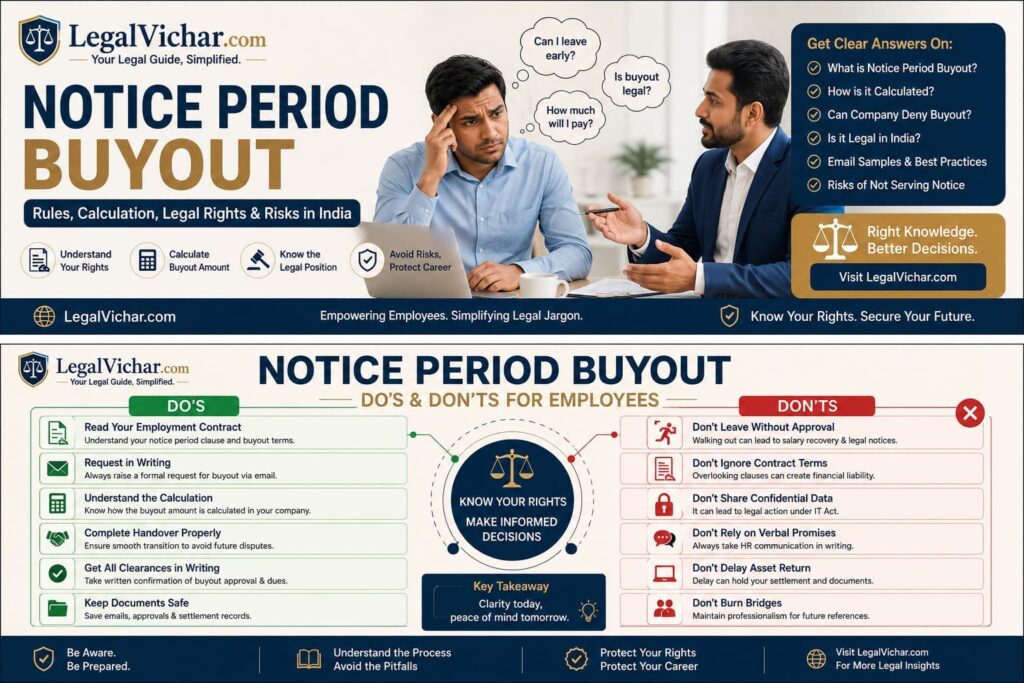
Is a 90 Day Notice Period Legal in India?
Yes, 90 day notice periods are common in Indian private sector employment, especially in IT and consulting industries.
Indian courts generally examine whether the clause is:
- Contractually accepted
- Reasonable
- Non coercive
Long notice periods are controversial because they sometimes affect employee mobility and career growth. Many employees lose new job opportunities because the next employer cannot wait 90 days.
Still, unless the clause violates labour protections or becomes exploitative, courts often treat it as a contractual condition voluntarily accepted during employment.
Can an Employee Resign Immediately After Joining?
Technically yes, but consequences may follow depending on the employment agreement.
Many companies include:
- Minimum service clauses
- Training recovery clauses
- Probation period conditions
- Joining bonus recovery terms
If an employee resigns within days after joining, the employer may attempt to recover onboarding expenses or notice compensation depending on contractual terms.
However, enforceability depends on whether the recovery amount is reasonable and legally sustainable.
Practical Situations Where Notice Period Buyout Becomes Complicated
Job Offer Pressure
A new employer may demand joining within 15 days while the current company insists on 90 days notice.
Toxic Work Environment
Employees facing harassment or hostile management may want immediate exit but struggle to obtain approval.
Medical Emergencies
Family emergencies or health concerns sometimes require urgent resignation.
Better Compensation Opportunity
Many employees prefer buyout because delaying resignation may result in losing higher salary offers.
International Relocation
Visa timelines often force employees to request early release.
Realistically, HR decisions depend heavily on internal relationships, project dependency, and managerial approval.
Notice Period Buyout and Employment Contracts
Employees rarely read employment contracts carefully during onboarding. But the notice clause becomes extremely important during resignation.
Before requesting notice period buyout, employees should check:
- Exact notice duration
- Salary recovery formula
- Whether approval is discretionary
- Buyout restrictions
- Probation rules
- Non compete obligations
- Bond clauses
Sometimes appointment letters use vague wording, creating confusion during exit.
For example:
“Company reserves sole discretion regarding notice waiver.”
This gives significant decision making power to the employer.
Employment Contract Risks
Stuck with a company bond while trying to resign?
Many employees fear legal action because of employment bonds and training agreements. Learn when such clauses are enforceable in India.
Read Company Bond Legal GuideSample Notice Period Buyout Request Email
A clear, polished, and professional format for requesting notice period buyout and early release from HR.
Dear HR Team,
I hope you are doing well.
I am writing to formally request consideration for notice period buyout against the remaining notice duration after my resignation dated [Date].
Due to personal and professional commitments, I would be grateful if the company could consider an early relieving date. I am willing to comply with the applicable buyout terms and complete all necessary handover formalities to ensure a smooth transition.
Please let me know the further process and any applicable recovery amount.
Thank you for your support and understanding.
Regards,
[Employee Name]
Can Companies Force Employees to Continue Working?
In most private employment situations, employers cannot physically force employees to continue working. Indian courts generally avoid enforcing personal service contracts except in limited situations.
However, employers may still:
- Recover contractual dues
- Delay relieving formalities
- Record policy violations
- Initiate legal communication
This is why employees should prioritise negotiated exits instead of abrupt departures.
Consumer Protection and Employee Rights Perspective
While employment disputes are not usually treated as consumer disputes, unfair corporate practices can still create legal complications.
For example:
- Excessive salary deductions
- Misleading HR representations
- Unreasonable bond recovery
- Deliberate experience letter withholding
may trigger labour disputes or civil legal claims depending on circumstances.
Employees should preserve:
- Appointment letters
- Resignation emails
- HR communication
- Salary slips
- Policy documents
Documentation becomes extremely important if disputes escalate.
Digital and Data Security Concerns During Notice Period
Modern workplaces involve extensive digital access. During notice periods, companies often monitor:
- Data transfers
- External downloads
- Client communication
- Confidential information access
- System usage patterns
Employees leaving organisations should avoid:
- Taking confidential files
- Forwarding internal emails
- Copying databases
- Retaining client information
Such conduct can create legal exposure under:
- Information Technology Act, 2000
- Confidentiality agreements
- Data protection obligations
- Employment contracts
This issue becomes highly sensitive in legal, IT, finance, and consulting sectors.
Notice Period Buyout in IT Companies
Indian IT companies are particularly known for lengthy notice periods.
Reasons include:
- Client transition
- Knowledge transfer
- Project continuity
- Resource allocation
- International delivery obligations
Large companies often follow strict HR systems for:
- Notice recovery
- Asset clearance
- Exit documentation
- Buyout approval hierarchy
Employees working in tech roles frequently negotiate partial buyouts where part notice is served and remaining days are compensated.
How Employees Can Reduce Exit Problems
Before resigning, employees should:
- Read the appointment letter carefully
- Maintain professional communication
- Avoid emotional confrontation
- Keep written approval records
- Complete handovers properly
- Return company assets on time
- Clarify buyout calculations in writing
Many exit disputes happen because employees rely on verbal assurances from managers that later get denied by HR.
Frequently Asked Questions
Click a question below to reveal the answer — fast, clear, and designed to help you understand your notice period rights and options better.
Yes, notice period buyout is generally legal if it is supported by the employment contract or company policy. The enforceability depends on the wording of the agreement and whether the arrangement is reasonable.
Yes. Many companies keep the discretion to approve or reject early release requests based on business needs, project dependency, and internal policy.
Most companies calculate it based on the number of remaining notice days and salary components such as gross salary or basic salary, depending on company policy.
Employers may adjust recoverable dues during full and final settlement, but arbitrary salary withholding can create legal issues.
In many private companies, 90 day notice periods are contractually enforceable unless they are found to be unreasonable or contrary to labour protections.
You may face salary recovery, delayed relieving documents, negative HR verification, or a policy violation record.
Yes. Improper exits or unresolved disputes can affect background verification and professional reputation.
Workplace Compliance & Employee Rights
Working another job secretly while employed? Read this before it creates HR trouble.
Moonlighting policies are becoming stricter in India. Employees should understand the legal and employment risks before taking freelance or secondary work.
Understand Moonlighting LawsConclusion
A notice period buyout is not merely an HR shortcut to leave a company early. It sits at the intersection of employment contracts, workplace negotiations, salary recovery, professional reputation, and legal interpretation.
Employees often focus only on joining the next company quickly, but poorly handled exits can create long term complications involving relieving letters, salary disputes, and future employment verification.
The smartest approach is usually a balanced one. Understand the employment agreement carefully, communicate professionally, document everything in writing, and negotiate rather than react emotionally.
In many cases, companies are willing to consider reasonable notice period buyout requests when the employee cooperates with transition formalities and maintains a professional exit process.
For employees in India, especially in private sector and IT roles, understanding how notice period buyout actually works can prevent unnecessary disputes and help ensure a smoother career transition.
Pingback: Employer Not Paying Salary? 7 Legal Steps to Recover Your Salary