
Introduction
You just found out your grandfather owned a piece of land that has been in the family for three generations. Is that ancestral property? Or is it inherited? And does the difference even matter?
It matters more than most people realise, especially when disputes arise, when you want to sell, or when a family member suddenly shows up claiming a share.
In India, these two types of property carry very different legal identities. Mix them up and you could make costly mistakes, whether you’re a buyer, a seller, or a legal heir trying to protect what’s rightfully yours.
This article breaks down the difference between ancestral property and inherited property in plain language, explains the legal framework behind each, and tells you what practically changes depending on which category your property falls under.
What Is Ancestral Property? The Foundation of the Concept
Ancestral property, under Hindu law, refers to property that has passed undivided through at least four generations of male lineage; from great-grandfather to grandfather to father to son, without any partition along the way.
The legal basis for this concept comes from the Hindu Succession Act, 1956 and the principles of the Mitakshara coparcenary system. In this system, certain male descendants (coparceners) acquire a birthright in the property the moment they are born. They don’t need to wait for someone to die or write a will.
A crucial point: in 2005, the Hindu Succession (Amendment) Act extended coparcenary rights to daughters as well. So a daughter born into a Hindu family that holds ancestral property now has the same right to a share as a son.

What Qualifies as Ancestral Property?
For a property to be truly ancestral, it must meet these conditions:
- It was originally acquired by the great-grandfather (or an earlier ancestor) from his own resources, not as a gift or inheritance from someone outside the four-generation chain.
- It has remained undivided, meaning no formal partition has been carried out by any generation.
- It has descended through a continuous line, from father to son (and, post-2005, to daughters as well).
If your grandfather earned money independently and bought land, that land in his hands is his self-acquired property. But once he passes it to your father and your father holds it without dividing it, it may start to take on the character of ancestral property for the next generation — though courts examine this carefully case by case.
But before we compare ancestral property with an inherited property, first we should understand what legally qualifies as ancestral property in the first place. Our detailed guide, What Is Ancestral Property? Your Complete Guide to Rights, Laws & Claims in India (2026), explains the concept, coparcenary rights, partition rules, and key court principles in simple terms.
What Is Inherited Property? A Different Legal Animal
Inherited property is far simpler to understand. It is any property received from a deceased person, either through:
- A will (testamentary succession): The deceased wrote a will naming you as a beneficiary.
- Intestate succession (without a will): The deceased died without leaving a will, and the property passes to legal heirs according to the applicable succession law (Hindu Succession Act for Hindus, Indian Succession Act for others).
When you inherit property, whether it’s a house, land, bank balance, or jewellery, it becomes your personal property the moment you receive it. You are its sole owner. Nobody else has a birthright in it unless you choose to give them one.
Key Features of Inherited Property
- Ownership is individual, not collective.
- The inheritor can sell, mortgage, gift, or will it away without anyone else’s consent.
- Rights do not arise at birth, they arise only upon the death of the person who owned it.
- It can be received under a will or through statutory succession rules.
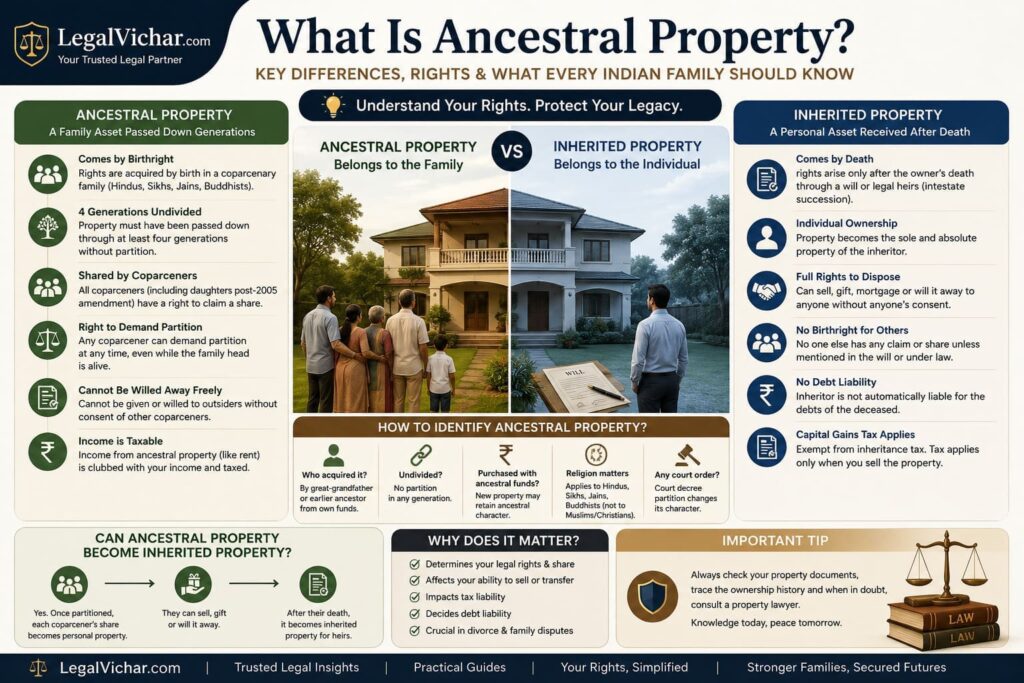
Ancestral Property vs Inherited Property: The Core Differences Side by Side
Understanding the difference between ancestral property and inherited property becomes clearest when you compare them directly across specific parameters.
1. How Rights Are Created
With ancestral property, rights are created by birth. The moment a coparcener is born into the family, they have a share, even if they’re a newborn and the property is still in their grandfather’s name. This is what lawyers call a “birthright.”
With inherited property, rights are created by death. Nobody has any claim on it until the owner passes away and the property is either distributed per a will or per succession law.
2. Who Can Claim a Share
In ancestral property, any coparcener, including daughters post-2005, can claim their share. Even an unborn child conceived before the partition has rights. This is what makes ancestral property disputes particularly complex and emotionally charged.
In inherited property, only the legal heirs of the deceased (or the persons named in the will) have any claim. There is no automatic right for the next generation.
3. Right to Demand Partition
A coparcener in ancestral property can walk into court and demand a partition, their legal share at any point in time, even if the head of the family is alive and reluctant. This is a powerful right that has led to many family court battles.
An inheritor of personal property has no such obligation to divide it. They own it outright and can do whatever they please with it.
4. Liability for Debts
Under the doctrine of pious obligation (now limited after the 2005 amendment), sons were traditionally liable to repay the debts incurred by their father in certain circumstances if the debt was tied to ancestral property. This obligation has been significantly curtailed, but the principle still exists in older case law.
Inherited property carried no such automatic debt liability for the inheritor.
5. Ability to Will It Away
An owner cannot will away their share of ancestral property to a stranger or an outsider without the consent of other coparceners though they can will their defined share once a notional partition is determined. The right to will ancestral property is constrained because others also hold rights in it.
Inherited property, being personal property, can be willed away to literally anyone a friend, a charity, or a distant relative. The owner has complete testamentary freedom.
6. Tax Treatment
The tax distinction is equally important. Ancestral property, when received as a coparcenary share, is generally not taxed as income (it is treated as a capital receipt). However, any income generated from ancestral property rent, for example, is clubbed with the recipient’s income and taxed accordingly.
Inherited property is exempt from inheritance tax in India (India abolished estate duty in 1985). However, if you sell inherited property, you will be subject to capital gains tax. The cost of acquisition for the purpose of computing capital gains is taken as the original cost to the previous owner who acquired it, along with indexation benefits.
Difference Between Ancestral Property and Self-Acquired Property
It’s worth pausing here to address the difference between ancestral property and self-acquired property, since this is where the most common confusion arises.
Self-acquired property is property that a person buys, builds, or earns entirely from their own resources, their savings, salary, or business income, with no nexus to any ancestral property fund.
The fundamental distinction:
- Self-acquired property belongs solely to the person who acquired it.
- They can sell it, gift it, or will it however they choose, with no obligation to share it with children or siblings.
- It only becomes “inherited property” in the hands of those who receive it after the owner’s death.
- Critically, self-acquired property does not automatically become ancestral property in the hands of the next generation, unless it was thrown into the common coparcenary pool and lost its separate character.
A practical example: Your father built a factory from his own earnings, with no connection to any family land or fund. That factory is his self-acquired property. He can sell it tomorrow without asking you. But if he inherited land from his own father and that land has been undivided through generations, that land likely carries ancestral character.
Which Property Is Ancestral Property? A Practical Checklist
People often ask: how do I know if a property is ancestral? Here are the questions to work through:
1. Who originally acquired it? If it was acquired by your great-grandfather or earlier male ancestor using his own means, it could be ancestral.
2. Has it remained undivided? If any generation carried out a formal partition — even an informal family settlement, the property loses its ancestral character from that point.
3. Was it purchased with ancestral funds? If your grandfather sold ancestral land and used the proceeds to buy a new plot, courts have sometimes held that the new purchase retains the ancestral character, especially if the family treated it that way.
4. Is the religion relevant? Ancestral property as a legal concept under the Mitakshara coparcenary system applies primarily to Hindus, Sikhs, Jains, and Buddhists. Muslims and Christians are governed by different personal law and inheritance rules where this concept does not apply in the same way.
5. Have courts been involved? Any court decree partitioning the property changes its character.
If in doubt, consulting a property lawyer with the original title documents and family history is the only reliable way to determine the ancestral status of a property.
Can Ancestral Property Become Inherited Property?
Yes, and this transformation is legally significant.
Once an ancestral property is formally partitioned, each coparcener receives their definite share. From that moment, their share becomes their personal property. They can then will it away, sell it, or gift it. When they die, their share passes to their legal heirs as inherited property, not as ancestral property.
So the same plot of land can change its legal character across generations depending on what the family does with it. A property that starts as ancestral in one generation can become self-acquired or inherited in the next if partitioned and then re-acquired by one person.
This is also why courts look very carefully at the chain of events, title documents, and family settlements when classifying property in a dispute.
Real-Life Scenarios Where the Difference Matters
Scenario 1: A daughter claiming her share Your father has held farmland that his grandfather acquired and nobody ever partitioned it. You are his daughter. Under the 2005 amendment to the Hindu Succession Act, you have a coparcenary right in this ancestral property. You can claim your share even while your father is alive.
Scenario 2: Selling property without consent Your father inherited a house from his own father via a will. This is inherited, his personal property. He can sell it without asking your permission. But if that house was truly ancestral (undivided for four generations), he would need to account for other coparceners’ shares.
Scenario 3: Debt liability A creditor is trying to recover a debt from your father. If the debt relates to ancestral property, the implications for the wider family may differ from a personal loan he took. Understanding the character of the property matters for your legal exposure.
Scenario 4: Divorce and property division When a marriage breaks down, the character of property matters. A spouse’s share in ancestral property may be treated differently from self-acquired property in matrimonial proceedings. For more on this, read our guide on Rights of Woman in Divorce (2026 Guide): Maintenance, Property & Custody Explained and How to Protect Assets From Divorce India: Legal and Practical Steps Before Things Get Messy.
FAQ: Common Questions on Ancestral Property vs Inherited Property
Q1. Is property received in a will considered ancestral property?
No. Property received through a will is inherited property — it becomes the personal property of the beneficiary. For it to be ancestral, it must have descended through at least four generations without partition, not through a will. A will can only transfer the testator’s existing rights.
Q2. What is the time limit to claim ancestral property in India?
Under the Limitation Act, 1963, a suit for partition of ancestral property must generally be filed within 12 years from the date the right to sue accrues. However, since a coparcener’s right exists from birth, the clock typically starts running when their share is denied or when another party takes adverse possession. Courts examine these timelines carefully, so consult a lawyer before assuming your claim has lapsed.
Q3. Can a father deprive his son of ancestral property?
No — not lawfully. Since the son (and daughter, post-2005) acquires a birthright in ancestral property, the father cannot sell, gift, or will away the entire ancestral property to the exclusion of other coparceners. Any transaction affecting another coparcener’s share without their consent can be challenged in court.
Q4. If I sell ancestral property, do I pay more tax?
Tax treatment depends more on how long you held it (long-term vs short-term capital gain) than on whether it was ancestral or inherited. However, for ancestral property, determining the original cost of acquisition for capital gains purposes can be complex, especially for old properties. A chartered accountant familiar with property taxation can help you compute the correct tax liability.
Q5. Does the concept of ancestral property apply to Muslims and Christians in India?
No. The Mitakshara coparcenary concept of ancestral property is specific to Hindu personal law (applicable to Hindus, Sikhs, Jains, and Buddhists). Muslims are governed by Muslim personal law (Shariat), and Christians by the Indian Succession Act, 1925. In these communities, inheritance operates differently — there is no concept of a birthright in property during the lifetime of the owner.
Conclusion: Know What You Own Before It Becomes a Problem
The difference between ancestral property and inherited property is not just legal trivia — it has real consequences for your rights, your tax bill, your ability to sell, and your family’s peace.
To summarise the key takeaway: ancestral property belongs to the family collectively by birthright; inherited property belongs to an individual personally. One comes with shared rights and restrictions; the other gives you full freedom.
Before making any decision, whether you’re planning to sell, buy, give, or claim property, make sure you know which category it falls into. Get the original title documents, trace the ownership history, and if there’s any doubt, speak with a property lawyer.